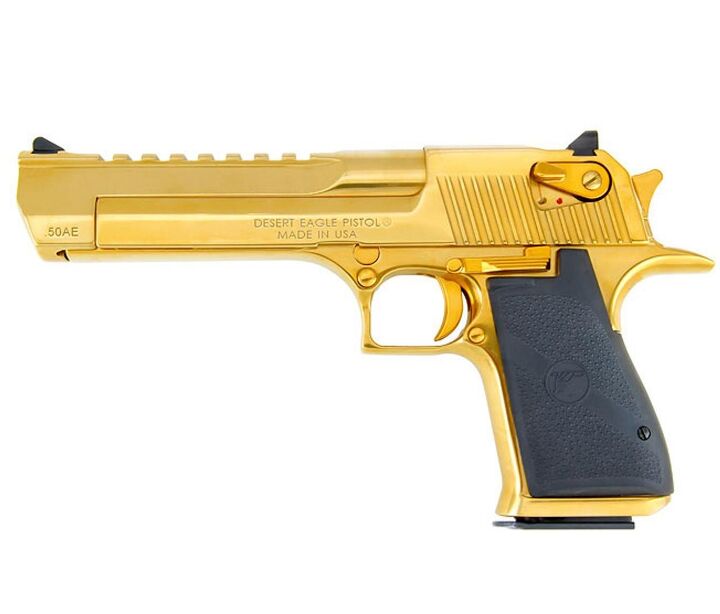
If you’ve watched an action movie within the last 40 years, you’ve likely seen the Desert Eagle in the hands of one of the actors. The large-caliber, gas-operated pistol is iconic and conveys “I mean business,” which is why it appears in Deadpool & Wolverine, The Matrix, Snatch, Eraser, Commando, RoboCop, Boondock Saints, Austin Powers, Terminator, and many, many more. The video game industry also loves this pistol, but is this admiration purely fictional, or is it rooted in practicality?
As you continue reading, you’ll discover why the Desert Eagle is abundantly more popular in pop culture than with the average gun enthusiast, based on the specs, variations (calibers and models), cost, and practical uses.
Brief Desert Eagle History & Manufacturers
Bernard White and Arnolds Streinbergs designed the Desert Eagle in the late 1970s and early 1980s and patented it in 1986. Israel Military Industries (IMI) was the first to produce the large-frame semi-automatic pistol and continued to do so for many years. Jim Skildum and John Risdall, Magnum Research’s founders, oversaw the Desert Eagle's ascent from development to pop-culture icon and eventually moved production of the pistol to Pillager, Minnesota, in 2009.
The first commercially available Mark I models appeared in 1983-1984, chambered in .357 Magnum. Today, the Mark XIX Dester Eagle is chambered in four magnum calibers: .357 Mag, .44 Mag, .429 DE, and .50 A.E.
Desert Eagle Calibers Explained
Desert Eagle pistols are chambered in four calibers, three of which are fairly common, and the fourth is lesser known.
.50 AE
The .50 Action Express (AE) is what most people associate with the Desert Eagle. It’s by far the favorite cartridge for the Desert Eagle because it’s BIG and BAD. The .50 caliber 300-325 grain bullet launches out of the muzzle at 1,400-1,600 fps, generating 1,400-1,800 ft-lbs of muzzle energy. It also has an impressively flat trajectory for a pistol cartridge, only dropping ~2 inches at 100 yards (depending on chosen bullet and sighted at 50 yards). However, these impressive ballistics come with a significant impact on the hands and wrists, with ~27 ft-lbs of free recoil energy (that’s three times the amount a 9mm recoils).
Other issues with the .50 AE include ammunition availability and cost. Not every gun and sporting goods store will carry .50 AE, and when you find it online, you should expect to pay over $1 per round for cheap bulk ammo and $2+ for higher-quality rounds.
Due to the issues above, the .50 AE is rarely practical. Unless you’re heading deep into grizzly country or just want to impress your buddies at the range, there’s not much of a practical reason to own this iconic Desert Eagle caliber. Some .50 AE enthusiasts use it for big game hunting and some shooting competitions, I must admit.
.44 Magnum
Though the .44 Mag was originally designed for large-frame revolvers, it’s a popular cartridge that the Desert Eagle is chambered in. With common bullet weights ranging from 158-340 grains blazing out of the barrel at 1,200-1,800 fps, generating 800-1,200 ft-lbs of free recoil energy. It will typically drop 3”-10” at 100 yards when sighted in at 25 yards. The recoil of the .44 Mag is no slouch at ~12 ft-lbs of free recoil energy, but significantly less than the .50 AE.
.44 Magnum ammo is also much more readily available and less expensive than .50 AE. It can be found for about $0.60 per round for bulk ammunition and over $2 per round for high-quality hunting and defense ammunition.
The .44 Mag is another good choice for deer hunting and bear defense, even though it’s less powerful than the .50 AE. While it’s a little more practical than the .50 AE, it’s not the most practical Desert Eagle caliber, but more so than the .50 AE. As long as you don’t mind owning and firing a less powerful round, the .44 Mag Desert Eagle is a solid choice.
.429 DE
The .429 DE was designed by Magnum Research specifically for the Desert Eagle (Mark XIX). It fires 210-325 grain bullets 1,400-1,750 fps out of the barrel with 1,285-1,400 ft-lbs of muzzle energy. When sighted in at 50 yards, it will drop 3-4 inches, depending on the exact load fired.
Because it’s a specialty round and only a few manufacturers produce it, .429 DE ammunition is more difficult to find than .50 AE and .44 Mag. It’s also much more expensive at $2.50+ per round.
Magnum Research intended the .429 DE to be a happy compromise of performance and recoil between the .50 AE and .44 Mag. While they have accomplished this, a limited number of shooters believe it was necessary, which is why it’s less popular than other cartridges.
.357 Magnum
I was introduced to the .357 Magnum by my grandpa, and I honestly didn’t like it. Throughout the years, I’ve grown to enjoy it and believe it’s the most versatile Desert Eagle caliber. .357 Mag bullets typically weigh between 125-180 grains, have a muzzle velocity between 1,100-1,500 fps, and generate 500-1,000 ft-lbs of muzzle energy. When sighted in at 25 yards, it will drop 4”-9”, depending on the load you choose.
.357 Mag ammo is the most readily available and least expensive of all Desert Eagle calibers. I’ve found ammo for it online and at nearly every sporting goods and gun store I’ve set foot in. You can expect to pay anywhere from $0.45 per round for cheap bulk ammo to $1.80 per round for high-quality defense and hunting ammo.
The .357 Mag is the most practical choice for hunting, black bear defense, and self-defense. If you want to shoot your Desert Eagle often, the .357 Magnum is the best choice economically and on your wrists, thanks to the lower recoil.
Desert Eagle Models & Variants
The Desert Eagle is available in several models and variations (you’re welcome to purchase a custom Desert Eagle if your pockets are deep enough).
Mark XIX
The Desert Eagle Mark XIX is the current model. It’s a gas-operated, semi-automatic pistol constructed using the latest CNC machining technology. It has an anatomical grip, ideal for comfortable two-handed shooting, and weighs about 72 ounces (unloaded).
Desert Eagle L5/L6
The Desert Eagle L5 and L6 are lighter versions of the Mark XIX. These models use an alloy frame to reduce the weight by nearly one pound. They feature a steel slide and barrel in various colors.
Baby Desert Eagle - Baby Eagle III
The Baby Eagle III is technically not a Desert Eagle. It’s a 9mm polymer-framed, full-size or semi-compact pistol designed to resemble a small Desert Eagle. The carbon steel slide is available in four colors and features an ambidextrous, teardrop-shaped decocking mechanism.
Limited Editions
The Limited Edition Desert Eagles, like the Titanium Gold model, offer custom colors and finishes to help your Desert Eagle stand out from the crowd a little more.
Desert Eagle Specs & Technical Details
- Weight: ~72 ounces (~4 pounds)
- Magazine capacity: 7 rounds (.50 AE and .429 DE), 8 rounds (.44 Mag), 9 rounds (.357 Mag)
- Dimensions:
- Barrel lengths: 6”, 7.2”, or 10”
- Overall Length: 10.75” or 14.75”
- Height: 6.25”
- Slide Width: 1.25”
- Trigger Reach: 2.75”
- Sight Radius: 8.5”
- Colors: Black, Black Tiger Stripe, Brushed Chrome, Burnt Bronze, Case Hardened, Polished Chrome, Titanium Gold, Titanium Gold Tiger Stripe, Tungsten, Black Cherry, and Carbo Blue
Prices & Where to Buy a Desert Eagle
Everyone knows the Desert Eagle is an expensive handgun, but just how expensive is it, and where can you go to purchase one? You can expect to pay anywhere from ~$1,900 to $3,600 for a new Desert Eagle, depending on the exact model, color, and caliber you choose. Unfortunately, the used market isn’t much better, but you can occasionally find a Limited Edition or a special color for less than you would pay for a new one.
You ask your local gun shop if they can get their hands on a Desert Eagle, but they’re easiest to find on online retailers. You’re also likely to find better deals online than at a gun show or gun shop. The KAHR Firearms Group website has lots of options, or you can custom-order one from MagnumResearchCustoms.com.
Shooting Experience & Practical Use
The Desert Eagle is a powerful pistol, but it is not the most powerful handgun. That title belongs to the Smith & Wesson Model 500, which is chambered in the .500 S&W Magnum. However, the Desert Eagle chambered in .50 AE is more than powerful enough for protection against giant grizzly bears and big, angry moose, so it’s no slouch. The Desert Eagle is a great gun for impressing people at the gun range and bear defense. However, I would never recommend it for self-defense or home defense against two-legged intruders because it’s large, heavy, has low(ish) magazine capacity, and most calibers carry a high risk of overpenetration. Besides hunting and taking it to the range, most gun enthusiasts love collecting Desert Eagles simply because they’re iconic and look awesome.
The recoil of the .50 AE is tremendous, but a muzzle brake helps reduce felt recoil, making it more manageable. The same is true for the .429 DE, which will have slightly less recoil than the .50 AE. I’ve found shooting my .44 Magnum Desert Eagle with a muzzle brake is pretty enjoyable. The recoil is very manageable after a little practice. Since the .357 Mag has the least recoil of all Desert Eagle calibers, it’s the most manageable to fire and enjoyable to shoot (for most shooters).
I’ve found it critical to keep my Desert Eagle well lubricated at the range and give it a good cleaning after each use. While it’s a reliable firearm, it definitely performs better when it’s clean and oiled.
Alternatives to Consider
There are several other large-bore handguns on the market, which may be the better option for your circumstances. Magnum Research makes the Biggest Finest Revolver (BFR) chambered in many different calibers that rival or exceed the power of the .50 AE. Smith & Wesson makes a few revolvers chambered in .44 Mag, .500 S&W Mag, and .460 S&W, among other calibers. Ruger also produces several handguns in powerful calibers that may be more practical in certain situations. This is by no means an all-encompassing list, but you get the idea: there are many alternatives in terms of power, but fewer semi-automatic alternatives. The AMT Automag and LAR Grizzly Pistol are two common semi-auto options.
Parting Shots: Desert Eagle Buyer’s Guide
In all honesty, very few shooters need a Desert Eagle, but many of us want one because of the image it represents. Raw power. The Desert Eagle is a reasonable option for bear defense and for occasional range use, but there are not many other practical reasons to own one. Mine spends most of its time in the safe because it’s expensive to shoot and more of a collector's item.
FAQ’s
What caliber is a Desert Eagle?
The Desert Eagle is available in four calibers: .357 Mag, .44 Mag, .429 DE, and .50 AE.
How much does a Desert Eagle cost?
A Desert Eagle generally costs $1,900 to $4,000.
How much does a Desert Eagle weigh?
A Desert Eagle weighs roughly 72 ounces or four pounds.
Who makes the Desert Eagle?
Magnum Research Makes the Desert Eagle.
When was the Desert Eagle made?
The Desert Eagle was first made in the early 1980s. The first one was released in 1983.
What does a Desert Eagle shoot?
Depending on the barrel, the Desert Eagle will shoot .357 Mag, .44 Mag, .429 DE, and .50 AE cartridges.
Is the Desert Eagle the most powerful handgun?
No, the Desert Eagle is not the most powerful handgun.
How many rounds does a Desert Eagle hold?
A Desert Eagle holds 7-9 rounds, depending on what cartridge it’s chambered in.
Is the Desert Eagle a good gun?
Yes, the Desert Eagle is a good gun for collecting, range use, and bear defense. However, it is not a good gun for self-defense.
How powerful is a Desert Eagle?
The Desert Eagle is very powerful when chambered in .50 AE. The giant .50-inch diameter bullet, which the .50 AE utilizes, generates 1,400-1,800 ft-lbs of muzzle energy. The striking energy of the .50 AE is often more than that of some rifle cartridges.