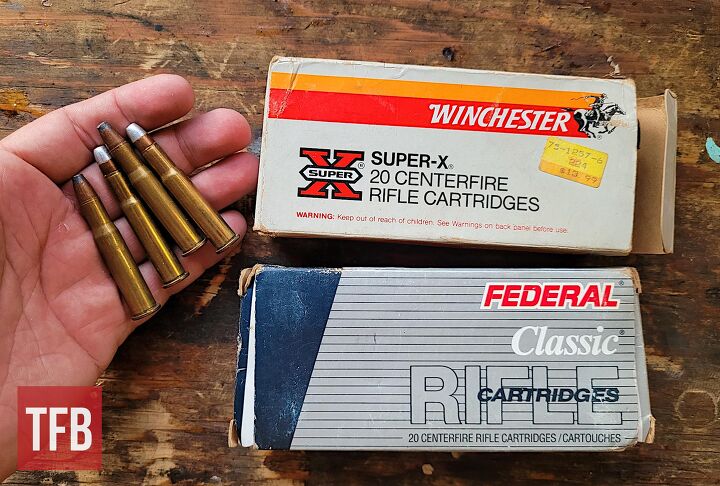
When I recently wrote an article about the demise of three classic hunting cartridges (the .257 Roberts, the .22 Hornet and the .300 Savage), one commenter said:
“Let’s finally put an end to an over-rated cartridge that has effectively been surpassed by a virtual plethora of better cartridges. Some lever-action rifle makers still chamber this old dog for some puzzling reason when there are so many new & better cartridges that make lever-guns incredibly better. Let’s blow taps on this ancient obsolete cartridge, and throw a last handful of dirt on the grave of the 30-30. RIP.”
I couldn’t disagree more. The .30-30 is better than ever, and I intend to buy another rifle, or rifles, to shoot it. Here’s why, and here’s why you should do the same.
Classic Fudd rounds @ TFB:
The .30-30 has been refined, and refined again
The .30-30 cartridge was introduced in 1895, more than 130 years ago, and it has come a long way since then. The original loading saw a .30-caliber, 160-grain jacketed bullet pushed by 30 grains of smokeless powder. The result was a 1970 fps load that had a flatter trajectory than blackpowder loads of that era, hitting hard enough to take down big game despite the smaller bullet.
Cartridge technology has come a long way since the 1890s, but so has the .30-30. While the casing’s dimensions haven’t changed, the bullets sure have. Originally loaded with blunt-nosed bullets due to the limitations of tube magazines, typical to most lever guns, you can now buy .30-30 rounds with streamlined, pointed bullets that extend the rifle’s practical range well past the 100 yards (or less) that shooters once restricted the round to. One of those new Hornady conical bullets, the 140-grain version, is also lead-free, so it can be used in states that require such ammunition.
If you’re perfectly happy using blunt-nosed bullets, there are beefy rounds from Buffalo Bore that can handle almost all the big game in North America. Winchester just released its new Lever Range of ammunition with a 150-grain hollowpoint that’s great for game, and also probably a good choice for … social work (more on that in a minute).
And the great thing about .30-30 factory loads is that most are very well-designed to work in the rifles that chamber this round. The ammo manufacturers know they’re almost certainly dealing with a 20-inch barrel; they know if they push a 150-grain or 170-grain bullet to 2,200 or 2,300 fps, they can expect good terminal performance as long as they get the basics right. You don’t hear a lot of stories about .30-30 bullets coming apart when they hit game. You see pictures of mushroomed points that got the job done.
The .30-30 is one of America’s great tactical cartridges
These days, the .223 reigns supreme in law enforcement, but once upon a time, the .30-30 was one of the most common rounds found in American law enforcement arsenals (the other was .30 Carbine). This goes back to the cartridge’s earliest days; the Texas Rangers were known to use .30-30 rifles (although the Arizona Rangers preferred the punchier .30-40 cartridge, since it could shoot right through a cactus). When retired Texas Ranger Frank Hamer went to chase down Bonnie and Clyde, he reportedly bought a Winchester Model 64 in .30-30 for the job, although he was using a Remington Model 8 for their fatal ambush.
But it wasn’t just lonely western lawmen toting lever guns for their work. State and city police departments issued .30-30 rifles. Missouri and Texas highway patrolmen were issued Winchester Model 94s, as were some Canadian RCMP detachments. Dallas, San Francisco, Los Angeles, Chicago and Toronto police departments had these rifles in their armories. Many jails also issued these rifles to guards.
And it went both ways; badmen used the .30-30 too. In the Kansas City Massacre of 1933, gangsters used a .30-30 rifle to fight law enforcement. Bonnie and Clyde reportedly used one in their crime spree. Tom Horn famously used one in his lethal vigilante work (and was hanged for his activities).
The .30-30s they used were relatively easy to shoot, with low recoil and a population that understood how they worked thanks to Western films. The .30-30 had plenty of power to down man-sized targets, but with less threat of overpenetration. The .30-30 lever-actions could be fired quickly, and their magazines could be topped up quickly.
All of these characteristics of the .30-30 are still true today.
There are a lot of .30-30s out there
Including the Miroku-made rifles and the original Connecticut production runs of the Model 1894 and Model 94, as well as others like the Model 55 and Model 64, Winchester made at least five million .30-30 rifles. Between the Model 1893, Model 36 and Model 336, Marlin probably made well over 3.5 million, too. Then add up the Savage rifles in .30-30 (bolt-actions, break-actions, lever-actions, pump-actions), the Mossbergs, the converted Schmidt-Rubin sporters, the H&R single-shots, the Remington Model 788s, the Henrys—you’ve probably got near 9 million .30-30 lever-actions, maybe more, and most of them are still in the United States.
Prices went silly during COVID-19, but it looks like there’s a bit of a return to normalcy again. As long as you’re fine with buying a brush gun, you can buy one with fine hand-fitted parts and a gorgeous finish from before World War II, or you can buy a beater sold at K-Mart in the 1970s with cheap stocks and a well-worn post-’64 sintered metal receiver. You can buy one with military markings (Canada issued Winchesters to the Pacific Coast Militia Rangers in World War 2). You can buy one with notches cut in the stock from moose and deer killed, then commemorated. And you can pay low money for a practical carbine for target practice or hunting, or big money for a rifle that will serve as the centerpiece of a collection.
In other words, there’s a .30-30 for almost everyone. If you just plain hate the cartridge and the rifles it was chambered in, well, that’s your choice. But for me, and most other hunters, the .30-30 has demonstrated what it can do, and it still does it well, and so do the rifles that chamber this round. I believe it’s only a matter of time, and I’ll have to get myself another.