Gun Control in Iran was Failing Even Before our First Strike
Iran had some of the strictest and most repressive gun-control laws in the world, under the Ayatollah.
Since they lack a constitution, Iranians have no right to own firearms.
Civilian firearms were regulated by the legislature, which took orders directly and indirectly from the Ayatollah.
For an Iranian civilian to legally purchase a handgun, a license was needed from the Iranian government. Officially, the process included a permit from local police, a criminal records check, military service checks, a psychological exam and successful completion of state safety training and testing. It was estimated that only 3% to 7% of all applications were approved.
Only this small number of licensees were legally allowed to purchase and possess ammunition.
In May 2025, longtime Iranian President Masoud Pezeshkian ordered even harsher criminal sentences for unlicensed firearm possession and for the use of digital platforms to arrange private sales.
Pezeshkian, it should be noted, was a member of a three-man council that tried, at least technically, to govern Iran. Earlier this month, Pezeshkian told his country that “bloodshed and revenge are Iran’s legitimate right and duty.” His current status is not known.
Pezeshkian’s most recent anti-gun laws threatened anyone involved with an “illegal” firearm, not just the owner. They targeted gun dealers, gunsmiths and anyone who offered training in firearm tactics. Penalties were severe—up to 15 years in an Iranian prison. Military weapons drew the stiffest penalties. The government could also seize the personal property of anyone that was accused.
Pezeshkian even targeted air guns with his new laws. Air gun owners were forced to turn in their arms or face severe sentences.
Online gun sales
Last year, Iran International, a London-based Iranian news agency, which covers the country with “fearless journalism,” investigated online firearm sales, which are thriving in Iran.
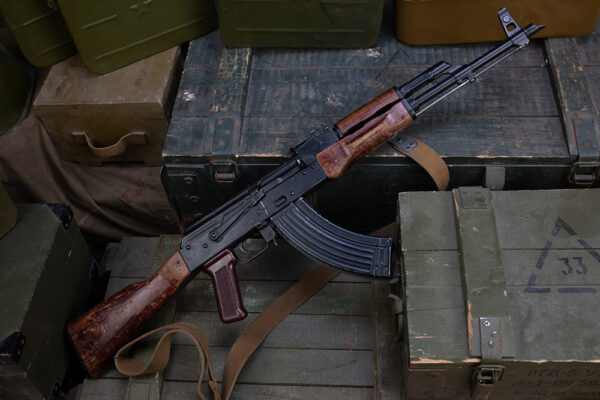
“In one 17,000-member channel, a vendor offered a Glock 17 pistol for 280 million rials ($340), a Makarov for 240 million ($290), and a Turkish-made Colt .45 for 360 million ($440). For higher-end buyers, a Kalashnikov was listed at 1.7 billion rials ($2,070), including a video showing it wrapped in cloth beside two full magazines,” the online magazine reported.
Security was tight on the websites. Payments were made via cryptocurrency, and purchased firearms were left in hidden locations. One seller used a shopping mall. After payment was made, the buyer had two hours to retrieve their purchases.
“The dealers who actually deliver have networks,” a source in Tehran told the website. “They use trusted people. Some even have police protection.”
The website found that while some of the sellers were questionable, there were enough legitimate ones to keep gun sales thriving.
Takeaways
Iranian civilians certainly have a legitimate need to arm themselves. It is difficult to understand the horrors they face under the current Islamic regime. They can be arrested, jailed and tortured on mere suspicion. Their security forces can shoot them dead on the street for no reason without any fear of a legal response.
While a $440 Turkish-made Colt .45 doesn’t provide the firepower required to save its owner from dozens of Iranian security forces armed with AKs, at least it offers the owner the ability to take a few with them.
This story is presented by the Second Amendment Foundation’s Investigative Journalism Project and wouldn’t be possible without you. Please click here to make a tax-deductible donation to support more pro-gun stories like this.
ATF Exposed: Bureaucrats Blocked Americans from Owning Post-1986 Machine Guns
Iran’s Power Vacuum Highlights the Importance of an Armed Citizenry
About Lee Williams
Lee Williams, who is also known as “The Gun Writer,” is the chief editor of the Second Amendment Foundation’s Investigative Journalism Project. Until recently, he was also an editor for a daily newspaper in Florida. Before becoming an editor, Lee was an investigative reporter at newspapers in three states and a U.S. Territory. Before becoming a journalist, he worked as a police officer. Before becoming a cop, Lee served in the Army. He’s earned more than a dozen national journalism awards as a reporter, and three medals of valor as a cop. Lee is an avid tactical shooter.