Hawaii Vampire Rule Struck Down: What Wolford v. Lopez Means
The Supreme Court just handed concealed carriers one of the cleaner Second Amendment wins of the post-Bruen era.
On June 25, 2026, the Court struck down Hawaii's so-called “vampire rule” in Wolford v. Lopez, ruling 6-3 that the state cannot force permit holders to get a property owner's express permission before carrying onto private property that's open to the public. Justice Samuel Alito wrote for the majority. The Court held the rule violates both the Second and Fourteenth Amendments.
This is a big win and we are going to break it down below.
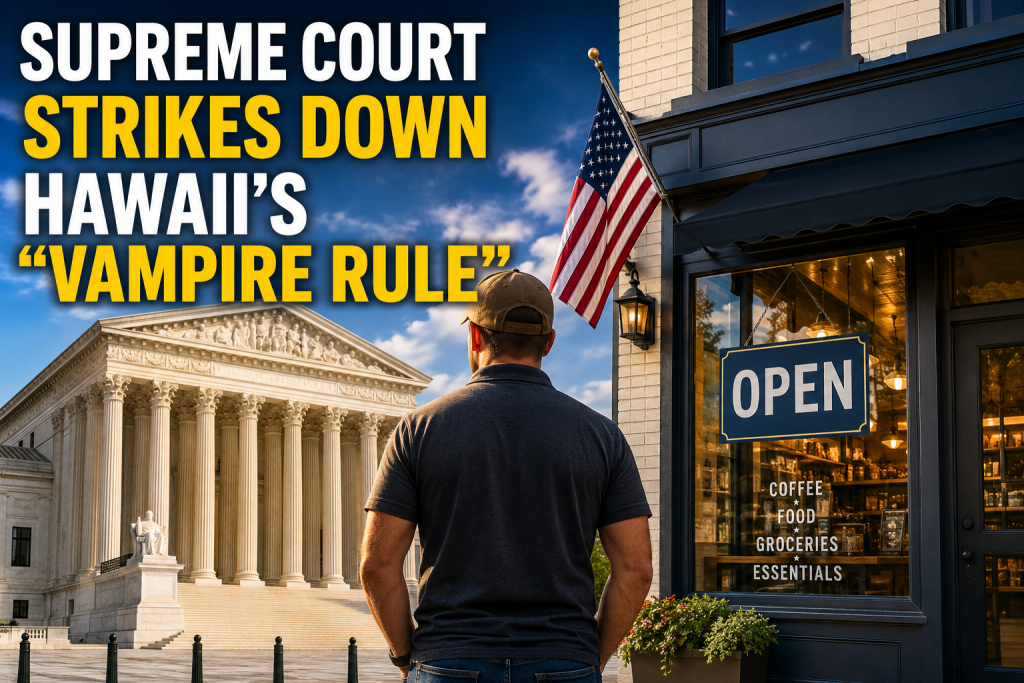
Image generated via AI for educational purposes
What the “Vampire Rule” Actually Required
Hawaii passed the measure in 2023, part of the state's response to the Court's landmark 2022 decision in New York State Rifle & Pistol Association v. Bruen. Rather than ban public carry outright (which Bruen forbids), Hawaii flipped the default.
Under the normal common-law rule, anyone has an implied license to walk into a business open to the public unless the owner says otherwise. Hawaii inverted that for gun owners. A permit holder could not legally carry into a gas station, store, or restaurant unless the owner had affirmatively said yes, in writing, by signage, or with a verbal okay.
Get it wrong and you were looking at a misdemeanor punishable by up to a year in jail. Critics nicknamed it the “vampire rule” because, like the creatures in Bram Stoker's Dracula, an armed citizen needed an invitation just to cross the threshold.
What the Court Actually Held
Alito's majority didn't soften the point. He wrote that Hawaii's regime “hobbles what the Second Amendment protects: the right of Americans to carry arms for self-defense as they go about their daily lives.”
The Court found the rule lacked any real grounding in the nation's historical tradition of firearm regulation, which is the test Bruen demands. Hawaii leaned on a handful of historical analogs, including an 1865 Louisiana statute. The majority rejected that one pointedly, noting it was part of the post-Civil War “Black codes” written to disarm freed Black Americans. On the state's broader defense, Alito's line has already gotten attention: the Second Amendment “has the same meaning in all parts of the United States,” and it “cannot give way to ‘the spirit of Aloha.'”
The bottom line: the default flips back. Licensed carry on publicly accessible private property is lawful again unless the owner chooses to prohibit it.
Read This Part Before You Celebrate Too Hard
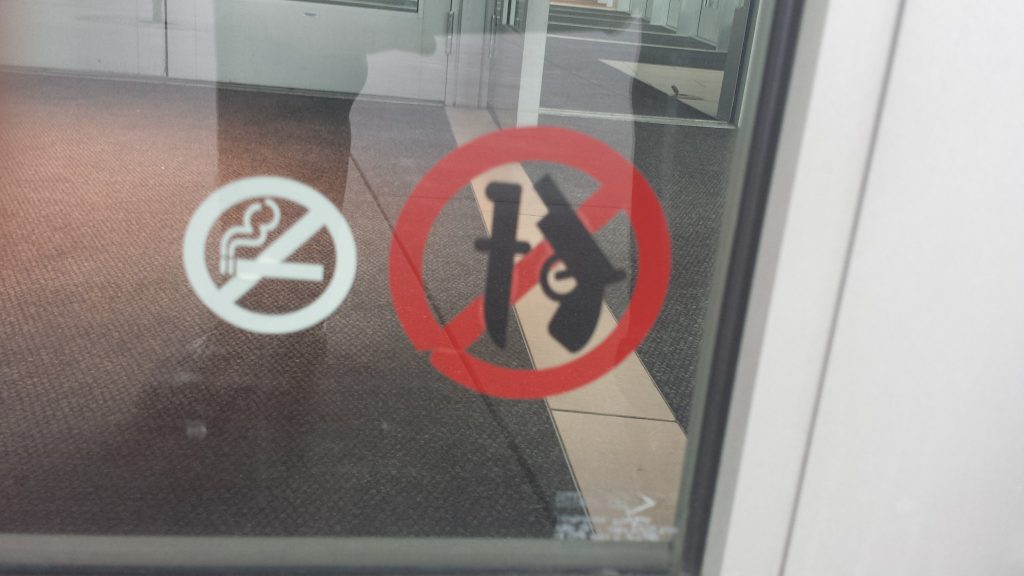
Sensitive Places
This is a real win with real precedential weight. It is not a blank check.
The ruling does not touch Hawaii's “sensitive place” restrictions. Schools, courthouses, and government buildings are still off limits. It also leaves alone the state's separate rules for bars, beaches, parks, and restaurants that serve alcohol, because those weren't part of this case (they're being fought in lower courts).
And don't forget private property owners can still ban firearms on their own property. The Court was explicit about that. A business can post a “no firearms” sign and that decision stands. What changed is the default. The state can no longer treat every business as a no-go zone unless the owner opts in. Now it's carry-allowed unless the owner opts out.
If you carry in a state with posted-sign laws, your habits shouldn't change much. Read the door. Respect the sign. The difference is that silence now means yes instead of no.
Why This Reaches Past Hawaii
Hawaii wasn't alone, and it wasn't even first. California, Maryland, New York, and New Jersey all wrote the same private-property default into their post-Bruen carry laws, flipping the rule so that carry was presumptively banned on property open to the public unless the owner affirmatively opted in.
It is worth noting that courts were already dismantling these one at a time. The private-property default has been struck or blocked in all four states, with the Second, Third, Fourth, and Ninth Circuits each rejecting the idea that a state can treat every business as off-limits by default. Maryland's version was blocked and its appeal was sitting at the Supreme Court's doorstep, waiting on this exact case.
Wolford v. Lopez should be the nail in the coffin. The Court just set one national rule where the circuits had been getting there ruling by ruling, and that leaves very little room for a state to run this play again.
The Dissent, and Why You'll Hear It
It was 6-3, and the three liberal justices weren't quiet about it. Justice Ketanji Brown Jackson, joined by Justice Sonia Sotomayor, argued the case was about property rights, not gun rights, and that there's no constitutional right to walk onto someone else's land armed. Justice Elena Kagan wrote separately, pointing to colonial-era laws she read as analogous.
It's worth understanding that argument, because you'll hear it repeated. The counter is straightforward: Hawaii didn't leave the decision to property owners. It made the state the gatekeeper and presumed every owner said no. That's the part the majority wouldn't accept.
What It Means for You
A few takeaways worth holding onto:
- If you carry in Hawaii, the default is now in your favor on publicly accessible private property. Posted signs and sensitive places still bind you.
- If you carry in California, Maryland, New York, or New Jersey, watch the follow-on litigation closely. The ground just shifted under those states' similar rules.
- Everywhere else, the lesson is the one we keep coming back to: knowing the law where you carry isn't optional. Signage rules, sensitive places, and reciprocity vary by state, and a win at the Supreme Court doesn't relieve you of doing your homework.
That last point is what actually keeps you out of trouble. The Constitution sets the floor. The details are where carriers get tripped up.
Rulings like Wolford v. Lopez are a good reminder that carry law shifts under your feet, and it shifts state by state. Our free mobile app puts the carry rules for all 50 states in your pocket, so you can check signage laws, sensitive places, and reciprocity before you walk in somewhere, not after. Download it, and stop guessing at the door.