History of the Second Amendment: Complete Timeline From 1328 to Today
I went looking for one source that covered all of it. It didn't exist. So I built it.
I've spent ten years and 800-plus episodes of this podcast talking about defensive gun use, training, and the legal landscape of concealed carry. Somewhere along the way, I went looking for one single article that laid out the complete history of the Second Amendment, start to finish, Northampton to Bruen, in one place. I couldn't find one. Plenty of pieces cover a portion of the history, a single case, or even several of the key moments in history. Nothing connects all 700 years into one comprehensive (and cohesive) timeline of history. So ahead of Independence Day this year, I decided to build the article I'd been looking for myself.
The main point I hope you take away from this? Every single era of American history, and English history before it, features someone in power trying to disarm a group or individuals they were afraid of. And every single time, the people who managed to keep their arms are the ones who kept their freedom. That's not just a statement of posture. It's the actual, documented pattern running underneath 700 years of history. So let's take a walk through history and review the receipts.
(And yes, this is also the theme of our July 4th sale this week. “Freedom bought with a gun, maintained with a gun.” More on that at the end. But I promise you, the history comes first.)
The English Origins of the Second Amendment
Many people think of the Second Amendment as an American invention. It isn't, or at least it didn't start there. The Founders were reacting to something they'd inherited, a centuries-long English habit of disarming whoever the Crown found inconvenient.
Go back to 1328. The Statute of Northampton made it illegal to go armed in public “to terrify the King's subjects.”1 This wasn’t a gun-control law in the modern sense. It's actually the origin of a distinction courts are still arguing about today: the difference between carrying lawfully and carrying to menace. (We'll come back to this. It shows up by name in the Bruen decision, 700 years later.)
Then things get uglier. Under Charles II and James II in the 1660s and 80s, the Crown used England's militia laws to straight-up disarm Protestants and political opponents it didn't trust, while conveniently arming and favoring Catholic loyalists.2 The intent wasn't about public safety. It was about control. Disarm the people you're afraid of, arm the people who'll do what you say.
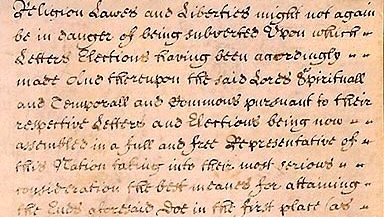
English Bill of Rights of 1689
That abuse is exactly what produced the English Bill of Rights of 1689, which declared that Protestant subjects “may have arms for their defence suitable to their conditions and as allowed by law.”3 Heller cites this clause by name as the direct ancestor of our Second Amendment.4 A century before Lexington, the English already understood the pattern: a disarmed people is a controlled people. They actually wrote it down and called it out.
One thing that's worth understanding is how the colonies inherited both halves of this coin. Many colonies legally required households to own arms for militia muster. Gun ownership as civic duty, not just permitted but mandated. At the very same time, several of those same colonies wrote slave codes specifically criminalizing firearm possession by enslaved people, and often free Black colonists too.5 Watch this pattern. It's going to come back twice more in this article.
One more setup piece before we get to 1775: in September 1774, British troops quietly seized a Massachusetts powder magazine outside Boston. No shots fired, and there were zero casualties, but it set off a regional panic and taught colonial citizens exactly what to watch for.6 Seven months later, when General Gage marched on Concord to do the same thing again, the colonists weren't caught flat-footed. They'd already seen this movie once.
Lexington, Concord, and the Bill of Rights
The War of Independence didn't start over taxes. I mean taxes and a lack of political representation gather the kindling and firewood. But the match was struck when British regulars marched on Concord specifically to seize colonial militia arms and powder stores. Armed colonists met them at Lexington and Concord, and that fight is what actually kicked off the war.7
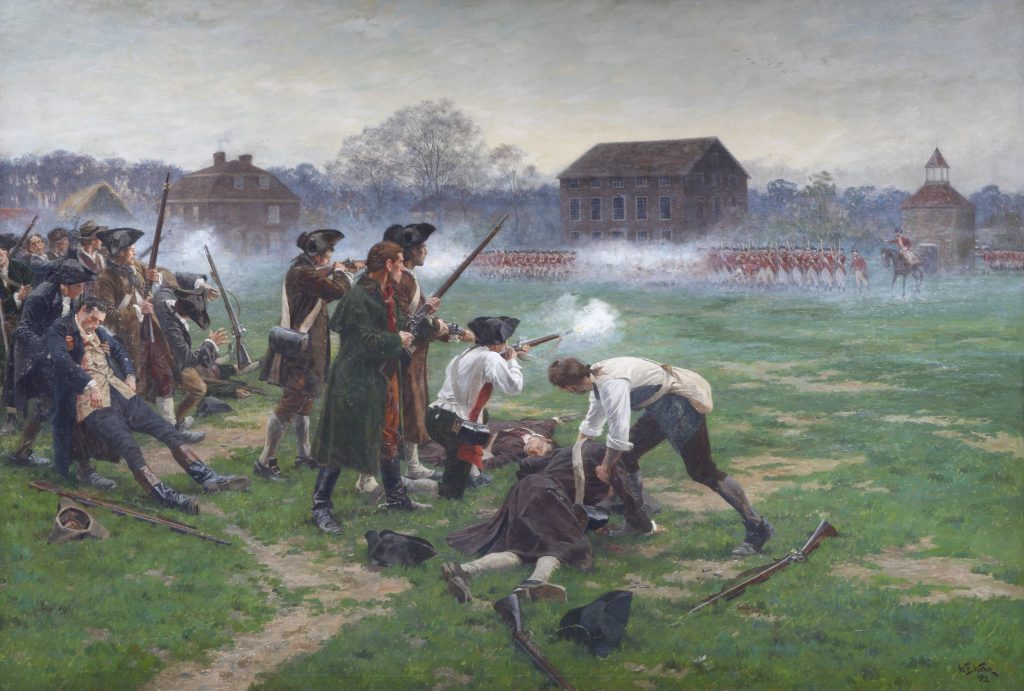
The Battle of Lexington
This is, hands down, the most literal “an armed people secured their own freedom” story in American history. The militia that responded that fateful morning was the same citizen-soldiery the colonies had spent 150 years building through mandatory arms ownership. The British came to take the guns. The colonists wouldn't let them. That's it. That's the whole sale banner, played out with muskets on a village green.
Sixteen years later, the framers put it in writing. The debate over the new Constitution had centered heavily on fear of a powerful standing army and a disarmed citizenry. Anti-Federalists demanded an explicit guarantee, and the result, ratified in 1791, was the Second Amendment.8
To help put some extra weight upon the idea of the Second Amendment being not just about maintaining an organized militia but also about an individual right to keep and bear arms, here are a couple of contextual examples that paint a picture of where the minds of the Founders lay:
The first draft language of the Second Amendment written by James Madison stated, “The right of the people to keep and bear arms shall not be infringed; a well armed and well regulated militia being the best security of a free country: but no person religiously scrupulous of bearing arms shall be compelled to render military service in person.” (emphasis added)9
Please note that the focus on the people bearing arms came first and had a more of an “individual right” flavor to it. Also, the semi-colon between this first clause and the “militia” clause created an even more distinctive separation between the two ideas. Linked, but not the same thing. A militia was important to the security of our free country, but first that required individually armed citizens. (The “religiously scrupulous” clause was, of course, completely removed later.)
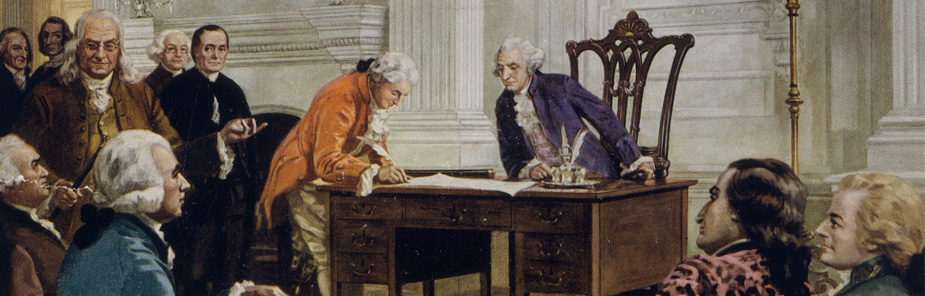
The drafting of the U.S. Constitution
To drive this point home even further, let's take a look at the wording of Pennsylvania's own Declaration of Rights in 1776:
“That the people have a right to bear arms for the defence of themselves and the state; and as standing armies in the time of peace are dangerous to liberty, they ought not to be kept up; And that the military should be kept under strict subordination to, and governed by, the civil power.” (emphasis added)10
Again, notice the focus on identifying the people as having a right to bear arms first in these clauses and the fact that it specifically calls out one purpose being for the “defence of themselves.” Granted, this is not the Constitution, but I think it gives us great insight into the minds and thinking of these early revolutionaries from around the time of our Nation's founding.
It should be clear: the framers didn't invent this right. They just personally observed their own history and that of their mother country and watched what happens when you don't have this right protected. And they took steps to ensure it could never be taken away again.
Dred Scott and The Black Codes
This is where I'd ask you to stick with me, because this next stretch of history is uncomfortable, and I think that discomfort is exactly why it matters for the “freedom maintained” half of our theme.
Dred Scott v. Sandford (1857) is widely considered the worst decision in Supreme Court history, and for good reason. Chief Justice Taney ruled that Black Americans could never be citizens, and in doing so, he explicitly listed the right “to keep and carry arms wherever they went” as one of the privileges of citizenship he was arguing against extending to them.11
Read that again. Even the justice trying to keep an entire group of Americans powerless understood, clearly enough to write it down, that an armed citizen is a free citizen. That's exactly why he fought so hard to keep the right from them.
Within months of the 13th Amendment abolishing slavery in December 1865, former Confederate states passed Black Codes specifically banning newly freed people from owning firearms.12 This wasn't a subtle act. Disarmament was one of the very first tools used to reimpose control the moment slavery's legal cover disappeared. It is directly why Congress tried to build arms-bearing protection into the 14th Amendment, but that amendment didn't get ratified until July 1868, two and a half years later.13 That gap in the history was taken full advantage of by these Black Codes.
Then comes the Colfax Massacre. In 1873, armed Black freedmen defended a Louisiana courthouse against a white militia during a contested election dispute. Most of them were killed after they'd already surrendered. It's still considered the bloodiest single act of racial violence of the entire Reconstruction era. The men responsible were indicted federally. In United States v. Cruikshank (1876), the Supreme Court threw the convictions out, ruling that the Second Amendment only restrained Congress, not states, and not private individuals.14
Translation: the freedmen had no federal recourse against the state failing to protect them, and no recourse against the mob that killed them, because the Constitution restrains the federal government, not your neighbors. That ruling helped clear the legal path for decades of Klan violence, and the interpretation regarding state and local governments wasn't reversed until McDonald v. Chicago, 134 years later.
The NFA and United States v. Miller
One fact that surprises a lot of people happens to be how the first major federal gun law in American history passed with almost no Second Amendment fight at all. And the reason why is worth understanding.
The National Firearms Act of 1934 taxed and registered machine guns, short-barreled shotguns and rifles, and suppressors.15 It landed in the middle of the Prohibition-era gangster crime wave. Capone, the St. Valentine's Day Massacre, Bonnie and Clyde, Thompson submachine guns in every headline. Attorney General Homer Cummings deliberately structured the bill around the federal taxing power instead of an outright ban, specifically because his own team knew a straight-up ban would run into the Second Amendment.16 And here's the part that always gets people: handguns were originally in the bill. They got pulled out at the request of the NRA.17
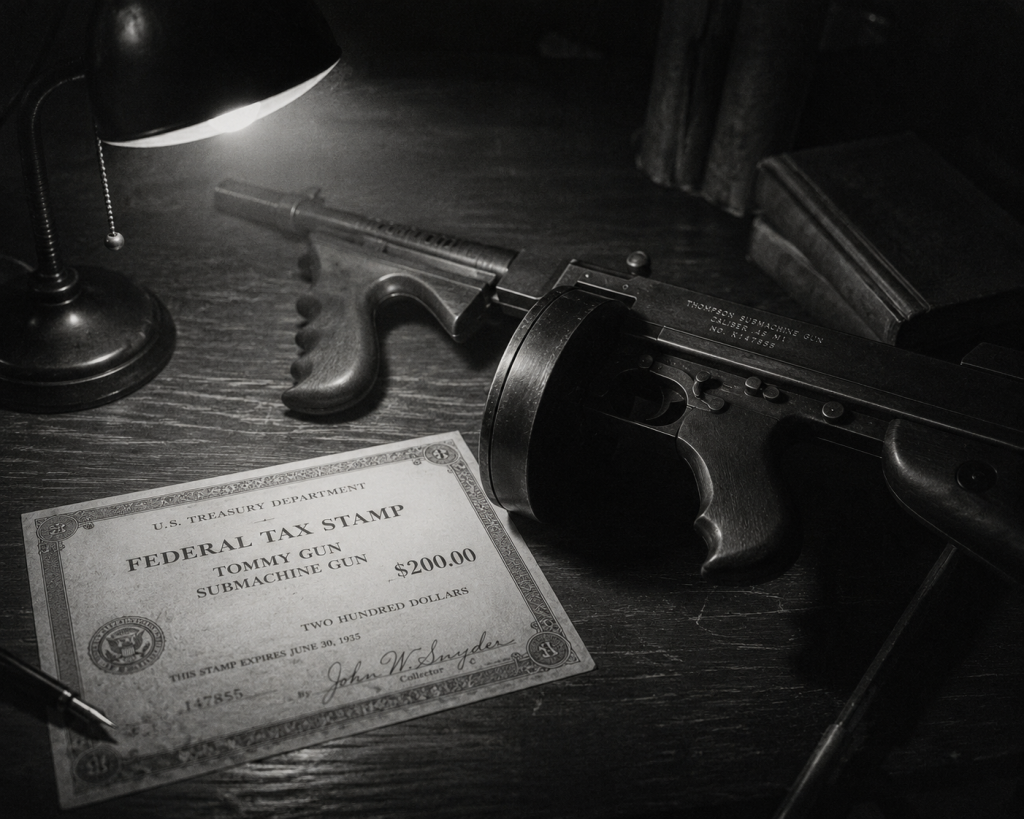
Thompson Submachine Gun Together With a Tax Stamp – Image created with the assistance of AI technology.
One unfortunate part of this story is that the NRA of 1934 wasn't just neutral on this bill. Its president, Karl Frederick, personally testified before Congress that he'd spent fifteen years helping write firearms regulations in multiple states, including D.C.'s own strict licensing law at the time. He told Congress flatly that he didn't believe in “the general promiscuous toting of guns” and thought carry should be “sharply restricted and only under licenses.”18 That's about as far from where the modern NRA stands as you can get, and I think it's worth sitting with rather than pretending it didn't happen.
The one real test of the law, United States v. Miller (1939), came from a case nobody actually fought. The defendant never showed up, no defense brief was ever filed, and the Court upheld the law based on the plaintiff's argument alone, ruling that a sawed-off shotgun had no demonstrated “reasonable relationship” to militia service.19
For nearly 70 years, lower courts cited that single sentence to reject almost every Second Amendment challenge that came their way. D.C. v. Heller didn't just overturn Miller in 2008. It reread it, focusing instead on a different phrase from the same paragraph: that militiamen were expected to show up with arms “of the kind in common use at the time.”20 That's the actual legal test we're still using today to argue about AR-15s.
Black Panthers and the Gun Control Act of 1968
In 1967, California banned public carry of loaded firearms. The bill was written specifically to disarm the Black Panthers' armed neighborhood patrols. It was NRA-backed and signed by Governor Ronald Reagan.21 And here's the detail that should make everybody a little uncomfortable regardless of which side of the aisle you're on: today's political “sides” of the gun debate weren't fixed yet in 1967. Both parties supported it.
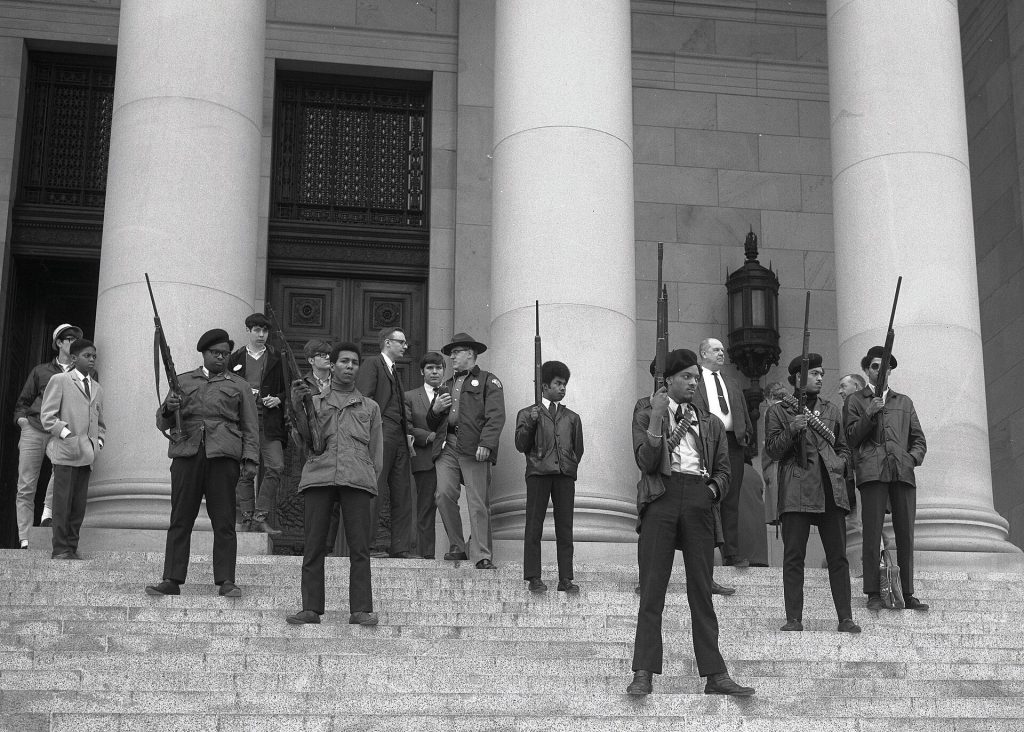
Seattle Black Panther party standing out of the Washington State Capitol building in Olympia, Washington in relation to the gun ban. Photo courtesy of the State Governors' Negative Collection, 1949-1975, Washington State Archives.
I'll give you the concede-pivot-verdict on this one straight: gun control's modern roots, at least in this instance, are explicitly racial. What I find genuinely remarkable is what happened this past January. A Ninth Circuit ruling, Baird v. Bonta, struck down California's modern open-carry restrictions, tracing the law's lineage directly back to Mulford, fifty-nine years later.22
California's open-carry ban started as a tool to disarm one specific group of Americans the state found threatening. Earlier this year, a federal court finally said that's not how the Second Amendment works. Full circle, almost six decades in the making.
The following year, 1968, brought the Gun Control Act, passed after the assassinations of Dr. Martin Luther King Jr. and Robert F. Kennedy. It created the federal firearms licensing system we still operate under, banned mail-order sales, and barred certain categories of people (convicted felons, mentally ill, and users of illicit drugs) from owning guns.23 It's the federal counterpart to Mulford's state-level response, same turbulent year, different level of government, same instinct toward tighter control of guns.
FOPA and One Very Sketchy Vote
Fast forward to 1986. The Firearm Owners Protection Act was a genuine win in many respects. It rolled back a lot of the ATF overreach that had been harassing ordinary dealers and collectors since 1968.24 But it came with an asterisk that gun owners are still paying for today, and I want to walk you through exactly how it happened, because most people don't know the details.
Late in House floor debate on April 10, 1986, Rep. William Hughes, no supporter of the broader bill, introduced an amendment banning civilian possession of any machine gun manufactured after the law took effect. It went to a voice vote, not a recorded roll call.25 Multiple accounts from that day describe the “nays” as audibly louder in the chamber. The presiding officer gaveled it through anyway. Republicans demanded a recorded vote and were denied. That procedural fight has genuinely never been fully settled. Courts eventually threw out legal challenges to it under something called the “enrolled bill rule,” which basically says once a law is signed, courts won't look behind the process that produced it.26
Here's the part that stings the most: NRA leadership at the time reportedly decided not to fight hard on this specific provision, choosing to preserve the rest of FOPA's protections rather than risk the whole bill.27 I'm not going to pretend that's not a defensible strategic call. It may well have been the right one at the time. We just don't know.
But the result is what you're living with right now: the transferable machine gun registry has been permanently frozen since May 19, 1986. Fixed supply, standing demand which is exactly why a transferable machine gun that cost a few hundred dollars in the early '80s runs you five figures today.
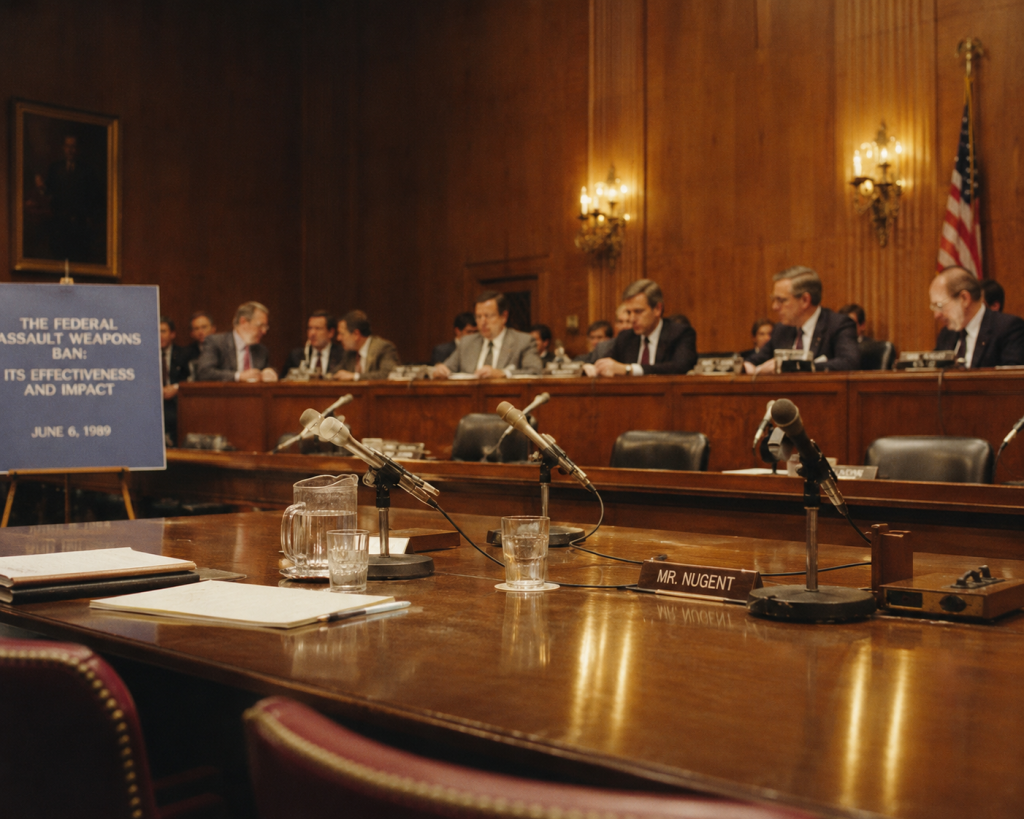
House Committee Hearing Re-creation – image created with the assistance of AI technology.
A few years later, the Brady Act (1993) brought mandatory background checks,28 and of course, the Federal Assault Weapons Ban (1994) banned a list of named semi-auto rifles and magazines over 10 rounds by cosmetic feature rather than function, and then, in 2004, it simply expired when Congress declined to renew it.29
Thank goodness for that sunset provision, or we might have had a harder time turning back the Federal AWB. It's interesting to note here that Congress mandated that a study be conducted to measure the effectiveness of the AWB during that 10 year span, and what they came away with was essentially that the ban had little to no effect on the reduction of violent crime or murders during that time.30
It's further noteworthy that one of the most infamous mass shootings to ever occur (Columbine) happened during the Federal Assault Weapons Ban and involved firearms and magazines that complied with the law.31 It's safe to say that the AWB did nothing to prevent Columbine.
The Individual Right, Restored: Heller, McDonald, and Bruen
For 70 years after Miller, lower courts treated the Second Amendment as tied to militia membership, not personal ownership. That changed in 2008.
District of Columbia v. Heller (2008) was the first Supreme Court case to clearly affirm an individual right to keep and bear arms, unconnected to militia service. It struck down D.C.'s handgun ban outright.32 This is, in a real sense, the payoff of everything we covered back in the English Inheritance section. Heller explicitly traces the right back to the 1689 English Bill of Rights.
But Scalia's own opinion also acknowledged there were limits. He wrote plainly that the right “is not a right to keep and carry any weapon whatsoever in any manner whatsoever and for whatever purpose,” and specifically preserved “longstanding prohibitions on the possession of firearms by felons and the mentally ill,” restrictions on carry in “sensitive places,” and conditions on the commercial sale of arms.33
Even Robert Levy, the Cato Institute director who funded the Heller litigation, later said he wished that paragraph hadn't been included. He called it something that “created more confusion than light.”34 Lower courts spent the next decade using it to uphold nearly every gun law already on the books, including D.C.'s follow-up restrictions in Heller v. District of Columbia (“Heller II,” 2011), where then-Judge Brett Kavanaugh dissented alone, arguing the majority had smuggled in a balancing test Heller never actually authorized.35
Two years after Heller, McDonald v. City of Chicago (2010) finally closed the exact gap Cruikshank opened in 1876, ruling the Second Amendment binds state and local governments too, not just Congress.36 It took 134 years, but the Court fixed the precise flaw that had left freedmen in Colfax with no protection at all.
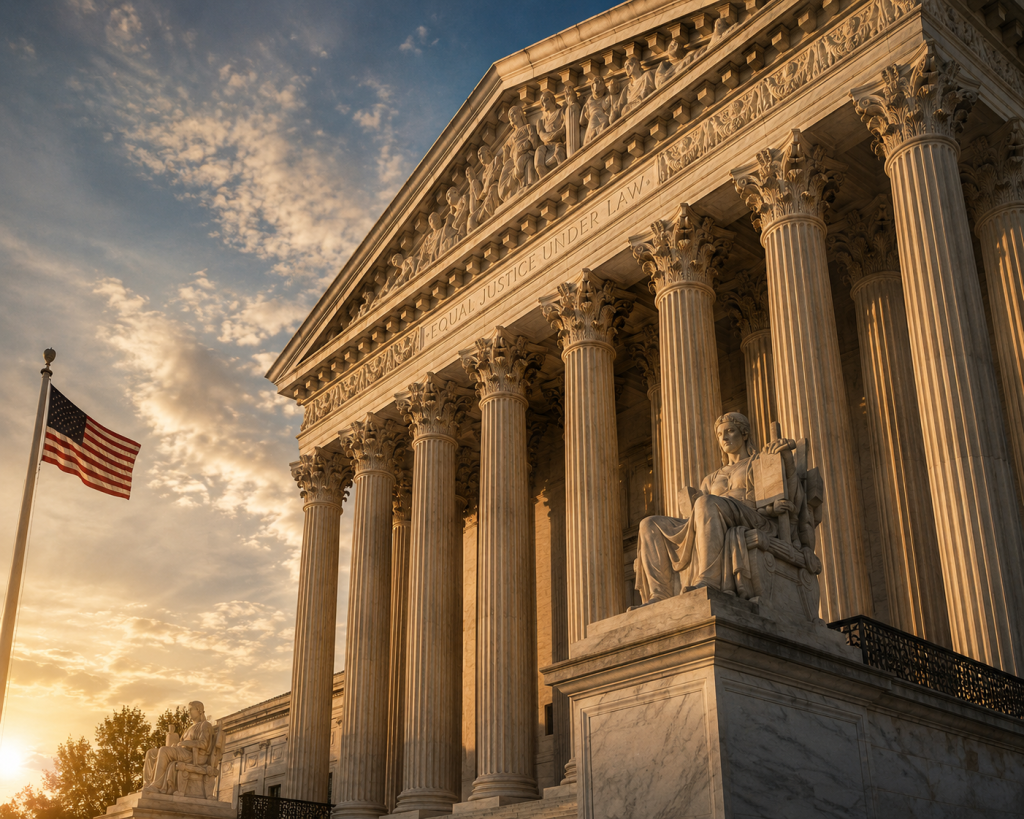
On the Steps of the Supreme Court – image created with the assistance of AI technology.
Then, in 2022, NYSRPA v. Bruen (2022) struck down New York's “proper cause” permitting scheme and established the test courts use today: modern gun laws have to be consistent with the nation's historical tradition of regulation, not just serve some government interest.37
This is the case that put the Statute of Northampton, that 1328 English law we opened this article with, directly into modern litigation, seven centuries after it was written. Bruen triggered an explosion of Second Amendment lawsuits nationwide. By 2024, Second Amendment cases were being filed at a rate of roughly 680 a year, compared with about 74 a year in the decade before the decision!38
And just two years after that, in 2024, United States v. Rahimi (2024) gave us the first real stress test of Bruen's new standard. It upheld, 8-1, a federal law disarming people under domestic violence restraining orders. Only Justice Thomas, Bruen's own author, dissented, arguing the majority had stitched together two mismatched historical laws to reach its result.39
Even a case as pivotal as Bruen isn't perfect, and it has been shown that some of these fights are not over. To a degree, Rahimi fundamentally demonstrated a “reigning in” of Bruen suggesting that a perfect historical analog need not exist to allow some gun control laws to stand.
The Future is Bright, But the Fight Isn't Over
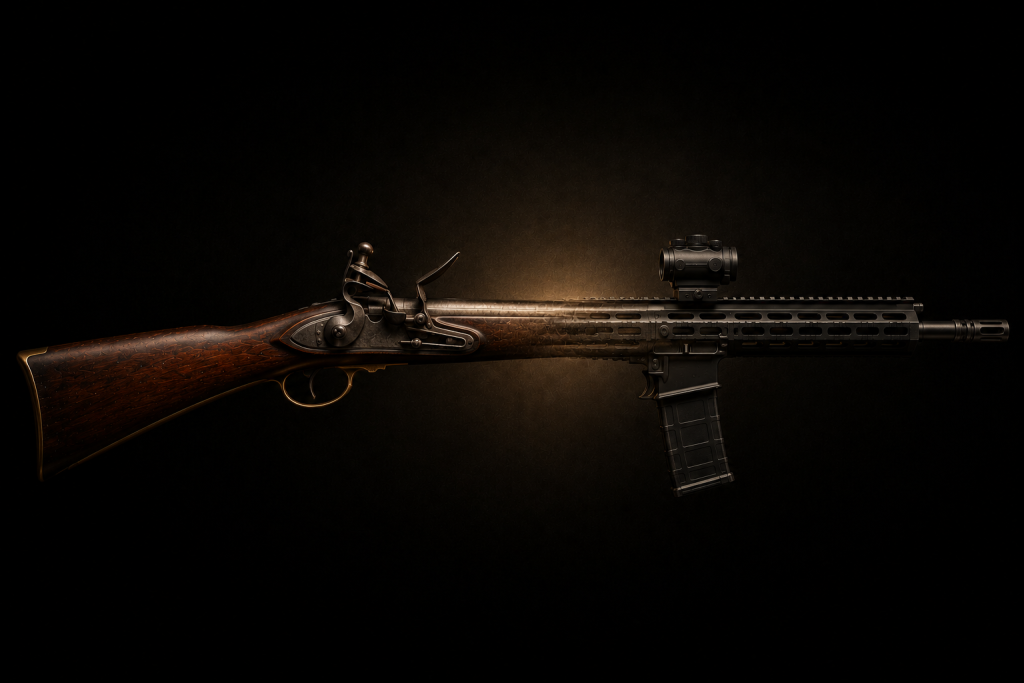
Musket AR-15 – image created with the assistance of AI technology.
We've taken a look at all of the major historical events leading us up to where we are now, from the British Crown to a colonial powder magazine outside Boston to the steps of the California Capitol to the marble steps of the Supreme Court. Every era in this history features someone trying to disarm a group they feared. Every era, the people who kept their arms kept their freedom eventually, even when it took 134 years and a Supreme Court reversal to get there.
But a review of the historical narrative shows that an individual's right to keep and bear arms does indeed exist and has been recognized for a long time. Ironically, even in some court cases that gutted the Second Amendment actually proved how that right exists whether judges and justices were willing to admit it or not.
That's not just wishful thinking. That's 700 years of receipts.
Jacob and I dig into every one of these stories (plus a lot of other detail) in this week's special Independence Day episode of the Concealed Carry Podcast. If you've made it this far, go listen to the full breakdown here: Freedom Bought, Freedom Maintained: 700 Years of Receipts
And if this history means anything to you heading into the holiday, if you believe the “freedom maintained” half of that sentence is worth actually preparing for, not just repeating, this is the week we're running our biggest sale of the year. Freedom bought with a gun. Maintained with a gun. Save big by going to www.concealedcarry.com/hba.
Remember our history. Honor it. Get involved. Stay armed. Stay free.
Frequently Asked Questions
What is the history of the Second Amendment?
The right didn’t start with the Founders — it started in England. The 1328 Statute of Northampton drew the first legal line between carrying arms lawfully and carrying them to menace the public, and by 1689, after the Stuart kings had spent decades selectively disarming political opponents, Parliament wrote an actual right to arms into the English Bill of Rights. That’s the clause Heller cites by name as the direct ancestor of our Second Amendment.
American colonists inherited that tradition and then lived through the sharpest possible version of it: British troops marching on colonial powder stores, culminating in Lexington and Concord in 1775. Fear of a standing army and a disarmed citizenry shaped the entire ratification debate that followed, and James Madison’s draft language became the Second Amendment in 1791.
The 130 years after that were messier than most people realize. Dred Scott (1857) and Cruikshank (1876) show the right being explicitly used and explicitly denied along racial lines, while the National Firearms Act (1934) passed with almost no constitutional fight at all. It took until 2008’s Heller for the Supreme Court to clearly affirm an individual right unconnected to militia service, 2010’s McDonald to bind that right to the states, and 2022’s Bruen to establish the historical-tradition test courts use today.
Where did the Second Amendment originate?
It originated in English common law, specifically the English Bill of Rights of 1689, which itself was a direct response to the Stuart Crown’s practice of disarming Protestant subjects it considered politically unreliable. That English right got filtered through 150 years of colonial militia tradition and the lived experience of Lexington and Concord, then James Madison drafted it into what became the Second Amendment, ratified in 1791.
Did the Second Amendment come from England?
Yes — at least its legal ancestry did. The Supreme Court’s own Heller decision traces the right directly back to the English Bill of Rights of 1689, which guaranteed Protestant subjects the right to “have arms for their defence suitable to their conditions and as allowed by law.” The American version went further than the English one, though: instead of a conditional right limited to one religious group, the Second Amendment protects the right as belonging to “the people” generally.
What Supreme Court cases shaped the Second Amendment?
Seven cases do most of the work:
-Dred Scott v. Sandford (1857) — Chief Justice Taney listed the right to “keep and carry arms” as a privilege of citizenship he was arguing against extending to Black Americans.
-United States v. Cruikshank (1876) — ruled the Second Amendment only restrained Congress, not states or private individuals, gutting federal protection for freedmen.
-United States v. Miller (1939) — the Court’s only word on the individual-rights question for the next 70 years, in a case nobody actually argued.
-District of Columbia v. Heller (2008) — first case to clearly affirm an individual right unconnected to militia service.
-McDonald v. City of Chicago (2010) — extended that right to bind state and local governments, finally closing the gap Cruikshank opened.
-NYSRPA v. Bruen (2022) — established the text-and-history test courts use today.
-United States v. Rahimi (2024) — the first real stress test of Bruen’s standard, upholding a targeted federal restriction 8-1.
When was the Second Amendment ratified?
December 15, 1791, as part of the Bill of Rights. James Madison’s original draft language went to the First Congress in June 1789; after revisions in the House and Senate, the final version was sent to the states and ratified two and a half years later.
What is the Statute of Northampton?
It’s a 1328 English law that made it illegal to go armed in public “to terrify the King’s subjects.” It’s the earliest legal source of a distinction courts still argue about today — the difference between carrying a weapon lawfully and carrying it in a manner meant to menace people. It’s not obscure trivia, either: the Supreme Court’s 2022 Bruen decision engaged with how this statute was historically interpreted, putting a 700-year-old law directly into modern Second Amendment litigation.
Footnotes
- Statute of Northampton, 2 Edw. 3 c. 3 (1328). See Statute of Northampton, Wikipedia (summarizing the statute's prohibition on going armed “to terrify the King's subjects,” and its treatment in N.Y. State Rifle & Pistol Ass'n v. Bruen, 597 U.S. 1 (2022)).

- Militia Act of 1662, 13 & 14 Car. 2 c. 3; James II's selective disarmament of Protestant subjects prior to the Glorious Revolution. See The Avalon Project: English Bill of Rights 1689, Yale Law School (recitals).
- English Bill of Rights, 1 W. & M. Sess. 2 c. 2 (1689). Full text, Avalon Project, Yale Law School.
- District of Columbia v. Heller, 554 U.S. 570, 593-94 (2008) (tracing the right to the 1689 English Bill of Rights). Opinion, Library of Congress.
- On colonial militia muster requirements alongside contemporaneous slave codes restricting firearm possession by enslaved and free Black colonists, see Slave Codes, Wikipedia.
- The Powder Alarm, September 1-2, 1774. Powder Alarm, Wikipedia.
- Battles of Lexington and Concord, April 19, 1775. Minute Man National Historical Park, National Park Service.
- U.S. Const. amend. II, ratified Dec. 15, 1791. On the standing-army debate driving ratification, see The Second Amendment, National Constitution Center.
- 1 Annals of Cong. 451 (1789) (Joseph Gales ed., 1834) (Madison's initial draft, June 8, 1789). Historical Background on the Second Amendment, Congress.gov Constitution Annotated.
- Pa. Declaration of Rights art. XIII (1776), in 5 The Federal and State Constitutions, Colonial Charters, and Other Organic Laws 3083 (Francis N. Thorpe ed., 1909), cited in Historical Background of the Second Amendment, Cornell LII.
- Dred Scott v. Sandford, 60 U.S. (19 How.) 393, 417 (1857). Milestone Documents, National Archives.
- On the 1865-66 Black Codes' firearm-possession bans, see Black Codes (United States), Wikipedia.
- U.S. Const. amend. XIV, ratified July 9, 1868. 14th Amendment, National Archives.
- United States v. Cruikshank, 92 U.S. 542 (1876). Summary and case background, Wikipedia; opinion text discussed in List of Firearm Court Cases in the United States, Wikipedia.
- National Firearms Act, ch. 757, 48 Stat. 1236 (1934). National Firearms Act, ATF.gov.
- On the deliberate use of the taxing power (modeled on the Harrison Narcotics Tax Act of 1914) to avoid a direct Second Amendment challenge, see NFA Firearms, Tax Stamps and Legal Challenges, USCCA (interview with Stephen Halbrook).
- Handguns were included in the original May 1934 draft and removed before passage at the NRA's request. National Firearms Act, Wikipedia; National Firearms Act of 1934, EBSCO Research Starters.
- Testimony of Karl T. Frederick, President, National Rifle Association, National Firearms Act: Hearings on H.R. 9066 Before the H. Comm. on Ways & Means, 73d Cong. 40 (1934). Full transcript (U.S. Government Printing Office), KeepAndBearArms.com; see also “The Forgotten NRA Leader Who Despised the ‘Promiscuous Toting of Guns,'” Washington Post.
- United States v. Miller, 307 U.S. 174, 178 (1939). Case summary, Wikipedia.
- Miller, 307 U.S. at 179, as reinterpreted in District of Columbia v. Heller, 554 U.S. 570, 622-25 (2008). Opinion, Library of Congress.
- Mulford Act, 1967 Cal. Stat. ch. 960. Mulford Act, Wikipedia.
- Baird v. Bonta, No. 24-565 (9th Cir. Jan. 2, 2026). Slip opinion, U.S. Court of Appeals for the Ninth Circuit; see also NRA-ILA coverage.
- Gun Control Act of 1968, Pub. L. No. 90-618, 82 Stat. 1213. Gun Control Act of 1968, Wikipedia.
- Firearm Owners' Protection Act, Pub. L. No. 99-308, 100 Stat. 449 (1986). Firearm Owners Protection Act, Wikipedia.
- H.Amdt. 777 to H.R. 4332, 99th Cong. (agreed to by voice vote, Apr. 10, 1986). All Actions, H.R.4332, Congress.gov.
- Farmer v. Higgins, 907 F.2d 1041 (11th Cir. 1990) (declining to look behind the enrolled bill in upholding 18 U.S.C. § 922(o)). List of Firearm Court Cases in the United States, Wikipedia.
- Account of NRA leadership's decision not to contest the Hughes Amendment, per former NRA lobbyist Richard Feldman and then-NRA executive vice president Warren Cassidy. “The Decades-Old Gun Ban That's Still On The Books,” NPR, Jan. 18, 2013.
- Brady Handgun Violence Prevention Act, Pub. L. No. 103-159, 107 Stat. 1536 (1993). Brady Handgun Violence Prevention Act, Wikipedia.
- Violent Crime Control and Law Enforcement Act of 1994, Pub. L. No. 103-322, tit. XI, subtit. A, 108 Stat. 1996 (sunset Sept. 13, 2004). Federal Assault Weapons Ban, Wikipedia.
- Christopher S. Koper, Daniel J. Woods & Jeffrey A. Roth, An Updated Assessment of the Federal Assault Weapons Ban: Impacts on Gun Markets and Gun Violence, 1994-2003 (Nat'l Inst. of Justice, 2004). Report abstract, Office of Justice Programs (DOJ).
- On the TEC-DC9 used at Columbine having been grandfathered under the 1994 ban's pre-existing-inventory exemption, see “Columbine 25 Years On,” History Today.
- District of Columbia v. Heller, 554 U.S. 570 (2008). Opinion, Library of Congress.
- Heller, 554 U.S. at 626-27. Opinion, Library of Congress.
- Robert Levy's reaction to the “presumptively lawful” dicta. District of Columbia v. Heller, Wikipedia (citing Levy's public comments following the decision).
- Heller v. District of Columbia (“Heller II”), 670 F.3d 1244 (D.C. Cir. 2011) (Kavanaugh, J., dissenting). Opinion, Justia.
- McDonald v. City of Chicago, 561 U.S. 742 (2010). Case summary, Oyez.
- N.Y. State Rifle & Pistol Ass'n v. Bruen, 597 U.S. 1 (2022). Opinion, Supreme Court of the United States.
- By 2024, roughly 680 Second Amendment cases were filed annually, compared with about 74 per year in the decade before Bruen. New York State Rifle & Pistol Ass'n v. Bruen, Wikipedia.
- United States v. Rahimi, 602 U.S. 680 (2024) (Thomas, J., dissenting). Opinion, Supreme Court of the United States.