Ignoring the No Guns Sign Is the Weakest Option
You know the sticker. Small pistol in a red circle, diagonal slash through it, mounted at eye level on a door you were about to walk through.
Ask around in most concealed carry circles about what to do next and you will get one of three answers. The sign isn't law, so ignore it. What they don't know can't hurt them. Better to be judged by twelve than carried by six.
I get all three. I've felt all three. And I think all three are answers to the wrong question.
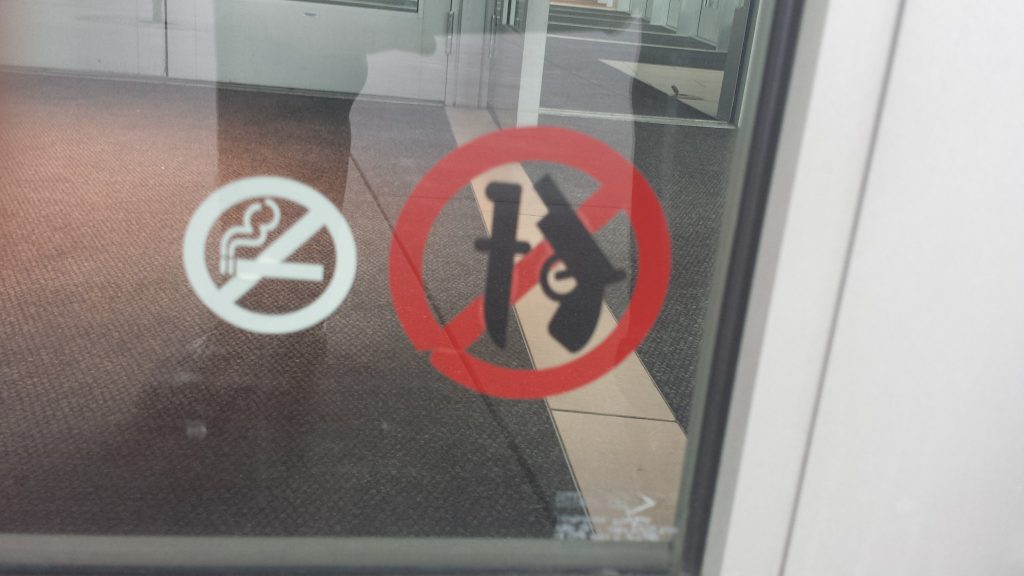
The argument we keep having is whether to carry past the sign or disarm and shop anyway. There's a third option nobody spends much time on, and it's the one I've landed on: don't give them your business at all.
This isn't a compliance lecture. I'm not here to tell you to lock your gun in the glovebox and go buy your patio furniture. I'm here to ask why that store is getting your money in the first place.
The Sign Question Is a Distraction
Let's clear the legal underbrush first, because it's genuinely different depending on where you live.

In some states, a properly posted sign carries the force of law and walking past it armed is a criminal offense with real penalties. In others, the sign means nothing until an employee asks you to leave, at which point staying becomes trespassing. In a handful of states, the sign has essentially no legal weight at all beyond a request.
Those distinctions matter enormously, and if you don't know which category your state falls into, you're carrying with a blind spot. We've covered both the difference between types of gun free zones and what actually happens when you get caught armed in one. Read both if you haven't.
But notice what the legal question does to the conversation. It turns the whole thing into a risk calculation about you. Will I get caught, and if I do, how bad is it?
That's a narrow way to look at it. Whether or not the sign has teeth, walking through that door is a transaction. You're handing a company money. And that money doesn't stop existing once it leaves your wallet.
Your Money Is a Vote, and Some Companies Count It
The usual objection to boycotting is that it's pointless. One customer is a rounding error. A few thousand gun owners quietly shopping somewhere else won't register against quarterly revenue in the billions.

Except we have a case where somebody put a number on it.
In February 2018, Dick's Sporting Goods announced it would stop selling certain semi-automatic rifles and standard capacity magazines and would not sell any firearm to anyone under 21. The company later estimated the policy change cost it roughly $150 million in lost sales, about 1.7 percent of annual revenue. Guns had also driven sales of boots, jackets, and other soft goods, so the damage spread past the gun counter.
The industry responded too. The National Shooting Sports Foundation expelled Dick's from membership, and manufacturers including Mossberg cut ties with the retailer entirely.
Now, here's the part I'm not going to spin. It didn't work, at least not in the sense of changing their mind. The CEO said it was worth it. The company doubled down, pulled hunting departments from store after store, and never reversed course.
So if you want the honest version: gun owners did not force a policy change at Dick's. What we did was make the decision expensive and visible enough that the company had to publicly account for it. Every retailer watching that story now knows there's a price tag attached to picking that fight.
That's not nothing. That's actually how consumer pressure usually works. It rarely flips the company that took the hit. It changes the math for the next ten companies deciding whether to take the same position.
Some of That Money Comes Back as Lobbying
For some companies, the no-guns policy isn't the end of their involvement. It's the opening move.
Levi Strauss asked customers to stop bringing firearms into its stores in 2016. Two years later the company went considerably further. It established a $1 million Safer Tomorrow Fund to finance gun control nonprofits and activists, partnered with Everytown and Michael Bloomberg to form a coalition called Everytown Business Leaders for Gun Safety, and doubled its matching rate for employee donations to aligned organizations while offering paid time off to volunteer for them. The first grants went to Everytown, Giffords, and Live Free.

Dick's went the direct route. Federal lobbying disclosures show the company retained three lobbyists from a Washington government affairs firm in April 2018, with “lobbying related to gun control” listed as the sole issue on the registration form. Not tax policy. Not retail regulation. That one item.
And this isn't confined to two companies. In 2022, Everytown announced that 515 companies and business leaders had signed a letter urging the Senate to pass new gun legislation.
Now, I'm not suggesting that every business that prohibits guns is actively hiring lobbyists and fighting against our rights but some do and I'm not inclined to give my money to any company that goes out of their way to deny me my constitutional rights and even more so a company that is actively campaigning to limit those rights.
The Safety Math, Done Honestly
You've seen the statistic. Some enormous percentage of mass shootings, happen in gun free zones. The exact % is debatable frankly but that isn't the point.

At least in some of these events we know from the shooters own words that they proactively chose a gun free zone as their target to carry out the deed.
After the March 2023 attack on a private school in Nashville, the police chief said investigators found the attacker had considered a different Nashville location and abandoned it after conducting a threat assessment that found too much security there. The attacker who killed ten people at a Buffalo supermarket in May 2022 wrote in advance about targeting areas where concealed carry is restricted. The Aurora movie theater shooter drove past several other movie theaters that allowed firearms to get to the one that didn't where he carried out his attack.
So another reason to avoid these gun free zones is that frankly you increase your risk by being there. The odds are statistically low that anywhere you go you will suddenly find yourself in the middle of a mass shooting but my point is simply that if you need one more reason to shop elsewhere this can qualify as one more reason.
“Judged by Twelve” Assumes You Had to Be There
Let's take the slogan seriously for a second, because it does contain a real idea. Given a choice between a legal problem and a mortal one, take the legal problem.
Fine. But look at the structure of that argument. It's a forced-choice framing, and the choice isn't forced.
“Better judged by twelve” is the right calculation when you're in a place you have to be, or a place you couldn't have anticipated, and something goes wrong. It's the calculation for a courthouse you were subpoenaed to, a hospital where your kid is being treated, or a street corner where an ordinary errand turned bad.
It is not the calculation for a home improvement store with four competitors within fifteen minutes. In that case the twelve-versus-six framing is doing something dishonest. It's dressing up a preference for convenience as a stand on principle, while quietly accepting a legal exposure you didn't have to accept and a tactical position you didn't have to be in.
You want to talk about principle? Principle is the drive across town.
How Inconvenient Is This Actually?
I said I'd be practical, so here's the practical part. In my experience the cost of this is much lower than people expect, but it isn't zero and it isn't evenly distributed.
Some categories are easy. Restaurants, coffee, hardware, groceries, sporting goods, gas, and most retail have real competition almost everywhere. Switching costs you a few minutes of drive time and a one-time hassle of figuring out where you're going instead. After that it's just your new normal. I couldn't tell you the last time avoiding a posted business cost me anything I noticed.
Some are harder. If you live somewhere rural with exactly one grocery store or one pharmacy within forty miles, this advice gets a lot more expensive. I'm not going to pretend otherwise from a keyboard.
And some are simply not boycottable, which is worth naming clearly. Your employer. Your child's school. The courthouse. The hospital. The post office. The airport. Government-mandated gun free zones aren't a business decision you can vote against with your wallet, and treating them the same way just leaves you unable to function. Those require a different strategy entirely, which is knowing the law cold and planning around it.
Which is exactly why the legal literacy piece matters so much. Knowing which signs carry criminal penalties in your state, which are trespass-after-notice, and which are advisory changes how you plan your week. Our mobile app contains a detailed list of places off limits by state which you may find helpful among the other resources contained in the app.
The Bottom Line
The community's default answer to a no-guns sign is to treat it as a personal risk calculation and then quietly ignore it. I understand the impulse. I just think it's small.
Ignoring the sign changes nothing. The policy stays. The lobbying money keeps flowing. The store keeps your business and keeps its posture, and the only thing you've accomplished is putting yourself on the wrong side of a trespass statute in exchange for a bag of dog food.
Going somewhere else does three things at once. It removes your legal exposure completely, it puts you in a building where you're not the only one who could respond to a problem, and it moves a dollar from a company that doesn't want you to one that does.