Illinois Ends Single-Shot Rifle Limit for Deer Hunters in 2027
The Illinois government has passed Senate Bill 2756 into law. The bill reforms the limitations on what firearms may be legally used for hunting deer in Illinois. The previous limitations allow centerfire rifles to be used if they are limited to one shot. Bill SB2756 passed the Senate third reading on April 15, 2026. It passed the House at third reading on May 21, 2026. Democratic Governor Pritzker approved the bill on July 24, 2026, now known as Public Act 104-0627.
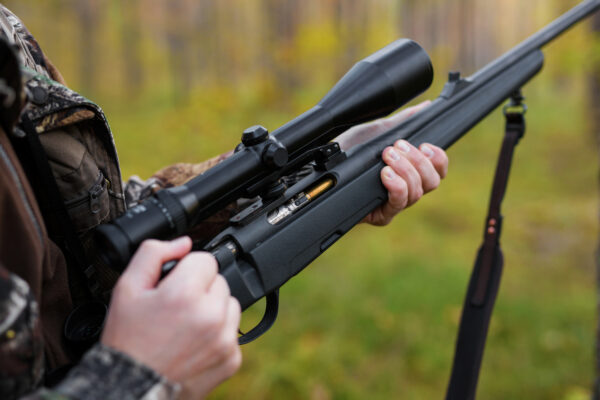
Beginning January 1, 2027, Illinois deer hunters will no longer be limited to single-shot centerfire rifles. Public Act 104-0627 will allow qualifying centerfire rifles and handguns capable of holding up to three cartridges in the magazine and chamber combined.
Centerfire rifles or handguns used to take deer are required to use either bottleneck cartridges of .30 caliber or more, with a case length of no more than 1.4 inches, or straight-walled cartridges of .30 caliber or more. The cartridges must be available in a factory round with manufacturer-published ballistics of 500 foot pounds or more of energy at the muzzle.
The .300 BLK case is 1.368 inches long. It meets the requirements. There may be other bottleneck cartridges that meet the requirements. The .357 magnum, 10mm magnum, .41 magnum, .44 magnum, and larger magnum calibers meet the requirements.
In addition to the cartridge case and ballistic limitations, many rifles and handguns are not eligible because of the extreme restrictions on how they may be rendered incapable of holding more than three cartridges in the chamber and magazine combined. If they can use removable magazines, it is very difficult to meet the requirements. From the law:
If a centerfire handgun or centerfire rifle is capable of holding more than 3 rounds, it shall be fitted with a one-piece plug that is irremovable without dismantling the handgun or rifle or it shall be otherwise altered to render it incapable of holding more than 3 rounds in the magazine and chamber combined without dismantling the handgun or rifle.
This appears to require more than merely placing a block inside a removable magazine. People are ingenious about solving such problems, but some solutions may cost more than purchasing a separate firearm that meets magazine limits.
Firearms that use blind magazines could be fitted with a block if they meet the other requirements. It would not be too difficult to use a plug similar to a shotgun plug for firearms that use tubular magazines. It appears most lever-action rifles that fire straight-walled cartridges that meet the cartridge requirements, such as .357 magnum, .41 magnum, 10 mm, .44 magnum, or larger cartridges, could be modified to meet the requirements with plugs to the tubular magazines. More powerful cartridges such as the .45-70, .444 Marlin, .405 Winchester, the .38-55, and the new .360 Buckhammer, .350 Legend, and .400 Legend meet the energy requirements, and appear to be legal if the firearm meets the magazine limitations.
Limitations on the number of shots held by hunting guns started being enacted with more restrictive game laws in the early 1900’s. The most famous of the early restrictions were from the federal regulation of 1935. The regulation limited migratory bird hunters to a three-shot limit per shotgun. The basis for federal regulation was the Migratory Bird Treaty of 1918. Some states put limits on the number of cartridges deer rifles could hold. Currently, according to battlbox.com, California has a ten-round limit; Colorado, Florida, and New York have five-round limits for some species. Illinois will now have a three-round limit for deer rifles.
Silencers/suppressors are not allowed for hunting or to be possessed by ordinary citizens in Illinois.
Removal of the single-shot limit for centerfire rifles to be used in deer hunting in Illinois is a small but real step toward more sensible game regulations in the state.
About Dean Weingarten:
Dean Weingarten has been a peace officer, a military officer, was on the University of Wisconsin Pistol Team for four years, and was first certified to teach firearms safety in 1973. He taught the Arizona concealed carry course for fifteen years until the goal of Constitutional Carry was attained. He has degrees in meteorology and mining engineering, and retired from the Department of Defense after a 30 year career in Army Research, Development, Testing, and Evaluation.