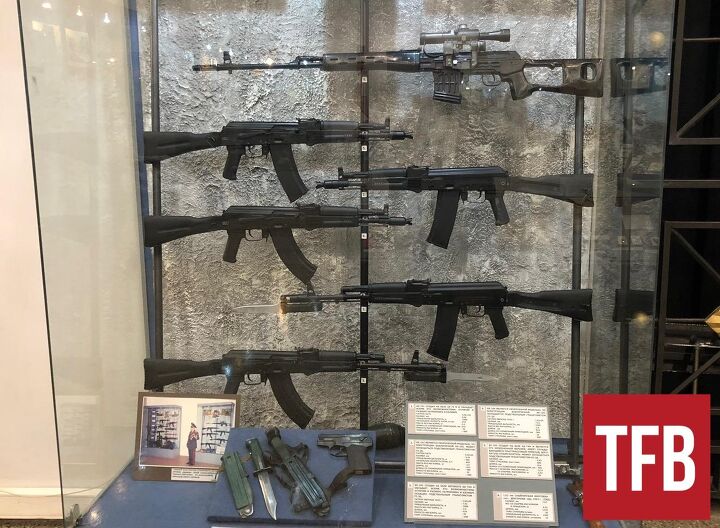
The AK-100 series was developed during one of the hardest periods in modern Russian history, in the years after the Soviet Union collapsed and the country was dealing with a deep economic crisis. In that environment in the early 1990s, Izhmash made the ambitious decision to create a new family of rifles for a new emerging market. These rifles would share as many parts as possible while still covering different calibers and barrel lengths.
The result was the AK-100 series of practical, export-focused weapons built around commonality. Rather than designing completely separate rifles for every role, the idea was to create a single family of weapons that could be easily manufactured for different users and requirements with minimal changes. That meant simpler production and fewer logistical headaches.
In many ways, the AK-100 series grew out of the Soviet AKS-74 and the Russian AK-74M, the latter adopted in 1991, which already laid the groundwork for the design. What set the AK-100 family apart was the emphasis on standardization across the lineup. Major internal and external parts were shared wherever possible, making the rifles easier to produce, support, and field. Though this standardization still meant “AK spec”, if you ever wondered why trying to replace an AK bolt with a new one and it is out of headspace or won't fit, that is a good example, as parts such as the bolt are close enough not exact duplicates of the technical data package.
The Guns
The AK-100 series includes several variants chambered for different calibers and different barrel lengths. The AK-101 and AK-102 are chambered in 5.56x45mm NATO, with the AK-101 using a standard-length 16-inch barrel and the AK-102 a shorter one, about 12.4 inches. These models were mainly intended for export customers using NATO ammunition.
The AK-103 and AK-104 are chambered in 7.62x39mm, a widely used cartridge. The 103 has a standard barrel, while the 104 is the shorter carbine version.
The AK-105 is the compact 5.45x39mm model, meant to serve as a short-barreled carbine for users already using Russian calibers.
There was no full-length 5.45 rifle in the series because the AK-74M already covered that role. Even so, the rifles in the AK-100 family still share a great deal in common, which was one of the whole points of the design.
From a manufacturing standpoint, this made a lot of sense. Using the same core components across multiple models reduced the need for separate production lines and simplified tooling. It also lowered costs and made it easier to scale production. In a time when budgets were tight and the international arms market was highly competitive, those advantages mattered. In theory, using the same front trunnions with different bullet guides, three different receivers (or just one opened up for different calibers), caliber-specific barrels and bolts, and, lastly, caliber-specific rear sights; all other components are the same for all models. This is the theory behind the 100 series, but in practice, that may be different.
The AK-100 series was also clearly designed with exports in mind, as well as for the domestic market. After the Soviet Union collapsed, Russian arms makers had to rely more heavily on foreign sales. Offering a rifle family that could be chambered in NATO calibers or in traditional Russian cartridges gave the AK-100 series a wider appeal. Some customers could move to 5.56x45mm, while others could keep using 7.62x39mm or 5.45x39mm without overhauling their existing supply system.
The series featured polymer furniture, and magazines helped cut some weight and improve durability in harsh conditions. Side-folding stocks made the rifles easier to store and carry and better suited for use in vehicles or airborne operations. Lastly, a few models, such as the AK-103-2, were developed with a 3-round burst mechanism installed at the end user's request, which was very easy to install.
Conclusion
Developed during one of the most difficult and uncertain periods in modern Russian history, the AK-100 series became one of the most successful product lines to emerge from the era. Built for a new export market needs, it showed a practical effort to simplify manufacturing while preserving the reliability that made the Kalashnikov name famous. One of the clearest examples of that success was the 7.62x39mm AK-103, which became one of the most prominent rifles in the series. Its reputation was reinforced by endurance testing, in which it reportedly survived 1,440 rounds before being stopped only by a stuck casing, suggesting it may have been capable of even more.
In theory, the AK-100 family was also cheaper and easier to produce than earlier rifles because of its greater parts commonality, which reduced machining and labor time. That combination of familiar design, manufacturing efficiency, and battlefield reliability helped make the series highly successful. As a result, the AK-100 line entered service and use across many parts of the world, securing its place as an important chapter in the history of modern Kalashnikov rifles.