July Gun Sales Rise 8.5% as NFA Checks More Than Double
Firearm-related background checks climbed in July 2026, with both the FBI’s raw National Instant Criminal Background Check System total and the firearm industry’s adjusted figure posting year-over-year gains.
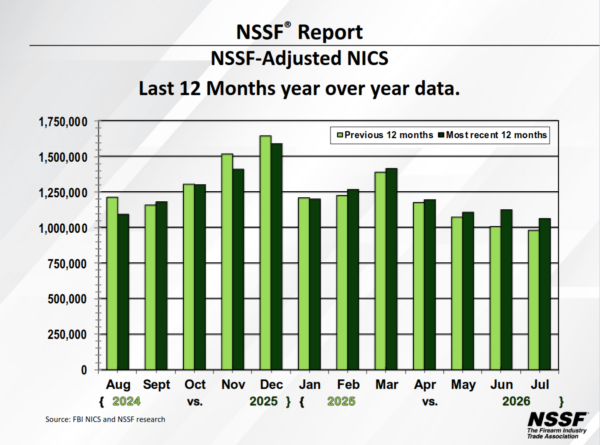
The headline number is the NSSF-adjusted NICS figure: 1,061,883 checks associated with likely firearm sales in July, up 8.5% from 978,731 in July 2025. The FBI’s unadjusted total reached 2,057,967 checks, a 6.3% increase from 1,936,621 during the same month last year.
The National Shooting Sports Foundation (NSSF) reported:
“The July 2026 NSSF-adjusted National Instant Criminal Background Check System (NICS) figure of 1,061,883 is an increase of 8.5 percent compared to the July 2025 NSSF-adjusted NICS figure of 978,731. For comparison, the unadjusted July 2026 FBI NICS figure of 2,057,967 reflects a 6.3 percent increase from the unadjusted FBI NICS figure of 1,936,621 in July 2025.”
Looking at the 27-year history of NICS reports, the number of firearm sales, as measured by the NSSF-Adjusted NICS, has had ups and downs. Over 10 years, from 2017 to 2026, the number has increased 17%, or compounded annually at 1.8%. This is about three times the increase in the population over the last 10 years. The census is conducted every ten years, so the population numbers are not as accurate as the NICS numbers.

Population does not appear to be the major driver of firearm sales. The effect of population numbers is relatively small. In this correspondent’s experience, political factors, both domestic and international, have had much greater impact. An extreme example is how the number of NICS checks done for National Firearms Act items such as suppressors, short-barreled rifles (SBR), short barreled shotguns (SBS), has skyrocketed once the $200 tax was removed in the One Big Beautiful Bill, which was signed by President Trump.
At the SHOT Show in Las Vegas in 2026, the ATF released a figure showing the official number of registered suppressors at 5.78 million. As of July 1, 2026, the number of registered suppressors is 6.50 million. This is an increase of .72 million suppressor in six months. Half a million of those have been added since April 10, 2026. A total of half a million suppressors were added to the National Firearms Registration and Transfer Record (NFRTR) from 1934 to 2006, over a period of 72 years. More suppressors have been registered in the USA in the last three months than were registered in the first 72 years of the infamous, and most likely unconstitutional, National Firearms Act.
From the NSSF:
The July 2026 NFA figure of 130,013 is an increase of 108.8 percent compared to the July 2025 figure of 62,271.
Analysis: Politics continues to be a major driver of firearms sales in the USA and worldwide. The suppressor figures show how much NFA sales have been politically suppressed (pun intended) in the USA. There is no evidence that the suppression of silencers has any measurable effect on violent crime. Also, there is no evidence that the suppression of short-barreled rifles or short-barreled shotguns has any measurable effect on violent crime. However, there is evidence that the widespread ownership of firearms suppresses crime, and scant evidence that firearm ownership increases crime. The overall evidence is that firearm ownership has a slight but measurable effect on decreasing violent crime.
The effects of political attempts to reduce firearms ownership have enormous effects on firearm sales. The more uncertainty in domestic and political politics, the greater the firearm sales.
About Dean Weingarten:
Dean Weingarten has been a peace officer, a military officer, was on the University of Wisconsin Pistol Team for four years, and was first certified to teach firearms safety in 1973. He taught the Arizona concealed carry course for fifteen years until the goal of Constitutional Carry was attained. He has degrees in meteorology and mining engineering, and retired from the Department of Defense after a 30 year career in Army Research, Development, Testing, and Evaluation.