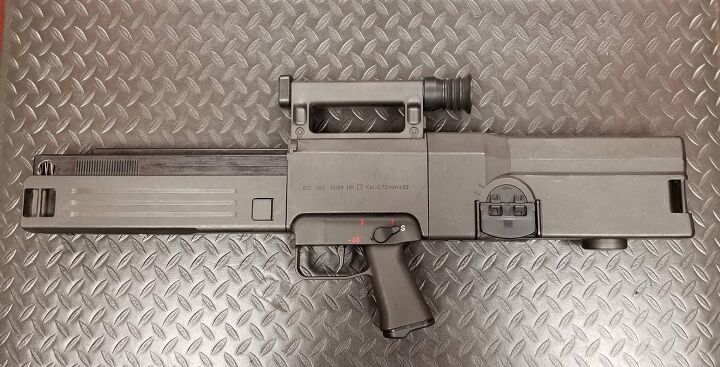
The G11 represents a peculiar Cold War tragedy: a rifle so technically advanced that it arrived exactly at the moment its creator could no longer afford it. Developed across two decades by a West German consortium and completed in 1990, this caseless-ammunition assault rifle was supposed to define NATO's second-generation infantry firepower. Instead, it vanished into H&K's Gray Room like a weapon from an alternate timeline that refused to happen.
What made the G11 extraordinary was its ambition to weaponize precision. The rotating chamber design and integrated Hensoldt optics were engineered to exploit a fundamental advantage: three-round bursts fired at over 2,100 rpm, with recoil delayed until all rounds left the barrel.
Hit probability doubled compared to the G3. The 4.73×33mm caseless round was half the weight of 5.56 NATO ammunition, allowing soldiers to carry significantly more firepower for the same load.
Reunification killed it. I was in Berlin the week before the Wall fell, as a teenager. Little did I know that when the Berlin Wall fell, Germany's defense budget evaporated along with the justification for a radical high-tech new rifle.
Only roughly 1,000 units were ever built. The G11 remains what might have reshaped modern infantry combat, eternally grounded.