Safety Glasses for Shooters: Standards, Fit, and Lens Selection
Watch a competent shooter run a range session and you will see a dozen safety habits executed without a second thought. Muzzle discipline. Finger off the trigger. Knowing what is behind the target. Hearing protection before the first shot and back on after every break.
Then look at what is on their face. Often it is a pair of flat prescription lenses from the mall, or a five dollar wraparound off a hardware store pegboard, chosen on the basis of costing five dollars.
Eye protection is the one piece of range equipment guarding something that is hard to repair and cannot be replaced, and it is consistently the line item people economize on. Part of that is cost. Most of it is that the category is genuinely confusing, the marketing is genuinely misleading, and almost nobody has explained what the markings actually mean.

The threat model is not your own gun
Most people picture a catastrophic failure when they think about eye injuries on a range. A firearm coming apart in your hands. It rarely happens, and when it does parts go a long way, but it is rare enough that it is the wrong thing to build your thinking around.
The realistic threats are mundane and constant:
- Splatter off steel. Fragmented jacket and core material comes back at you or other shooters.
- Brass from the next stall or shooter. It comes back at your face from an angle you are not watching.
- Debris. Dirt, gravel, and vegetation kicked up by anything happening near you.
- Whatever the guy two bays over is doing.

These polymer targets from Throom are safer than steel.
That last category deserves more weight than it usually gets. There is no good injury data specific to shooting ranges, so nobody can put a number on it, but the pattern is that a meaningful share of eye injuries are not caused by the person wearing the glasses. You are minding your own business and somebody else's problem arrives at your face.
My own closest call was on a range in Arizona with a tall berm and shooting bays on both sides of it. Objects were coming down out of the sky into my bay. Not constantly, just occasionally. I picked one up off the ground and it was a bullet. Over about forty minutes I watched three or four come down. One hit me in the forehead hard enough to leave a mark.
I still do not know what was wrong with that range. Bad berm geometry, a rock in the wrong place, steel where it should not have been. The point is that I was doing everything correctly and it made no difference. A range is a semi-predictable environment, which means it is also a partly unpredictable one, and the whole job of eye protection is managing that gap.
The brass injury nobody warns you about
Hot brass landing in your eye is bad. Hot brass wedging between your lens and your eyeball is worse.
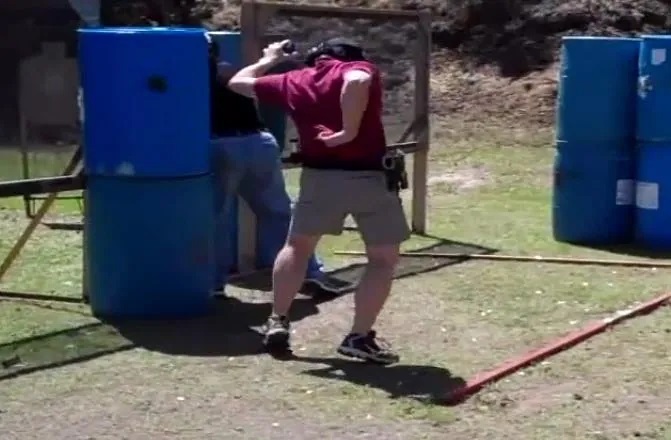
If you think the hot brass dance is dangerous when hot brass goes down your shirt, just imagine what it will be like when it wedges in your glasses
The brass does not bounce away. It sits there against your eye, still hot, while you try to clear it with one hand and manage a loaded firearm with the other.
Wraparound coverage is what closes the path. Not because a lens needs to stop a casing, but because there needs to be nowhere for one to land.
Reading the standards, and the marketing built on top of them
This is where most buying decisions go wrong, because there is language on packaging that is technically accurate and functionally deceptive.
Not every ANSI standard is a safety standard
ANSI publishes a standard for non-prescription sunglasses. It is called Z80.3, and it governs things like light transmission and optical clarity. It says nothing about impact resistance.

The safety standard is ANSI Z87.1. That is the one about impact.
A company can print “ANSI approved” on a package of ordinary sunglasses, be telling the literal truth, and sell them to you as safety glasses. This happens. If the packaging says ANSI without saying Z87, you have learned nothing about whether the lens will stop anything.
Z87 and Z87+ are not the same rating
Basic Z87 is a drop ball test. A one inch steel ball falls fifty inches onto the lens and nothing may break or come loose.
Z87+ is the high impact rating, and it requires two harder tests. A high velocity test fires a quarter inch steel ball at the lens at 150 feet per second, roughly 102 miles per hour, at multiple specified impact points. A high mass test drops a pointed 500 gram weight from fifty inches. In both cases the lens cannot fracture, nothing can break loose from the inside of the protector, and on the velocity test the lens cannot deflect far enough to contact the eye of the test headform.
Two things follow from that. First, Z87+ is the floor for range use, not Z87. Second, both the frame and the lens need to carry the plus mark for the assembly to count as high impact. A high impact lens in a basic frame is a basic assembly, because the frame is what has to hold that energy in place.
The markings are molded into the product. Check the temple arm and the lens edge.
The military standard, and why “ballistic” is a nickname
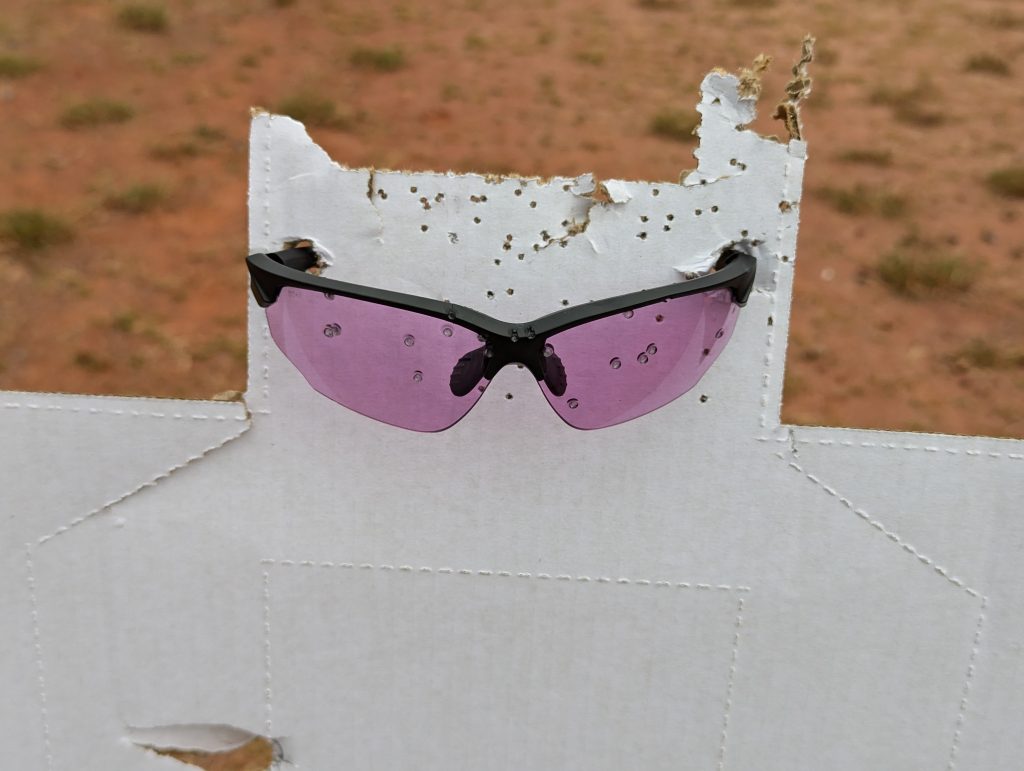
Shot these with a shotgun at The Guardian Conference to prove a point.
The tier above ANSI is MIL-PRF-32432, the U.S. military combat eye protection specification. Products that pass end up on the Army's Authorized Protective Eyewear List.
Instead of a steel ball, it uses fragment simulating projectiles, which are chisel-tipped steel fragments machined to behave like shrapnel. For spectacles the test fires a 0.15 caliber, 5.85 grain projectile at 640 to 660 feet per second. Goggles get a heavier 0.22 caliber, 17 grain projectile at 550 to 560 feet per second.
Put the spectacle numbers against the Z87+ steel ball and the military test carries roughly four times the velocity and between six and seven times the impact energy.
That is a large jump, and it is worth understanding what it is not. People call this the ballistic standard. It is a fragmentation standard. Nothing in this category stops bullets, and no manufacturer worth buying from claims otherwise. What you are buying is margin against fragments, splatter, and debris, which is exactly the threat you actually face.
Nobody is auditing any of this
Compliance with Z87.1 in the United States is self-certified. The manufacturer runs the tests, reports the results, and no independent body is required to verify anything on an ongoing basis. Molds change. Suppliers change. Tolerances drift. The certification reflects a design as tested, not a guarantee about the unit in your hand.
Testing also costs money per model, which cuts in an unexpected direction. Plenty of frames would pass a higher standard but were never submitted, because a company will only pay to certify a few models in a line. That is understandable, especially for a smaller business or manufacturer.
Coverage: why wraparound geometry buys you two things
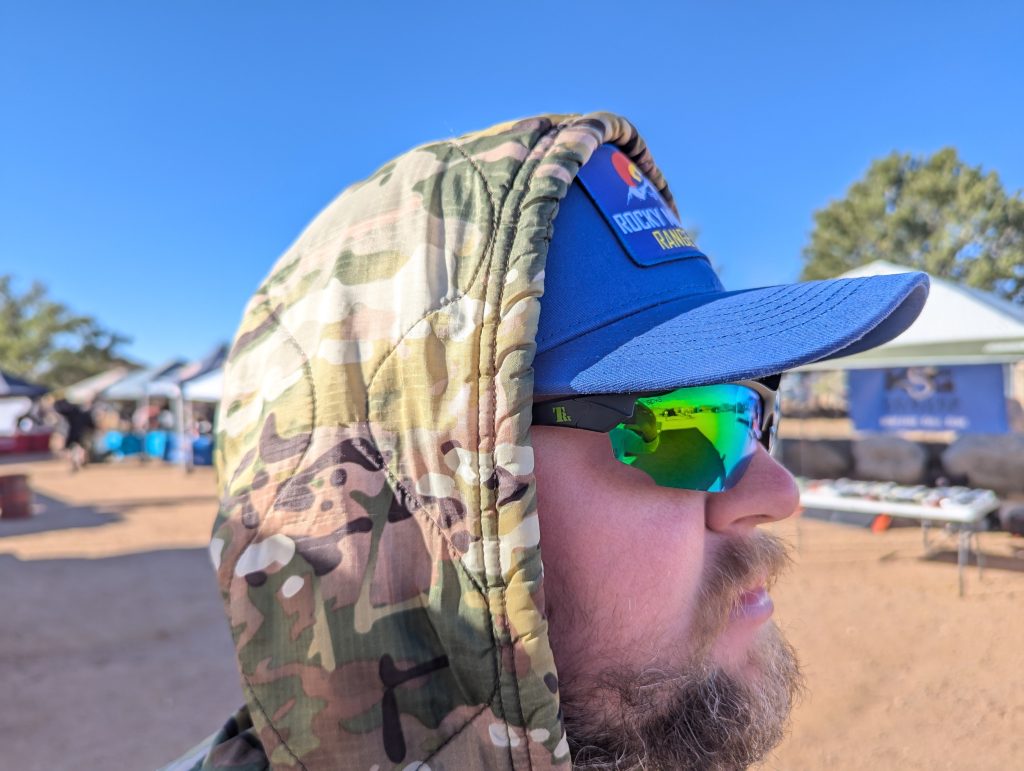
The obvious benefit of a curved lens is coverage. Less open space around the edges means fewer paths for brass and debris to reach your eye.
The less obvious benefit is peripheral vision. The old approach to protective eyewear was a flat lens with side shields attached, and those shields sat directly in your peripheral field. A properly curved lens gives you the coverage without the blinders.
Prescription wearers get a third benefit, which is that a curved lens carries correction out to the edges of your field where a flat lens does not. People moving from flat everyday glasses into curved prescription lenses routinely report their peripheral vision improved, because for the first time it is actually corrected.
Fit is not a comfort issue
Wraparound coverage does absolutely nothing if there is a gap. A pair that seals perfectly on one person's face can leave a half inch channel at the temple on yours, and that channel is a direct path for a piece of brass.
Human head geometry varies far more than the market accommodates. The industry builds nearly everything to a medium fit, because that captures most of the population and the outliers on either end are not worth the tooling cost. If you have a small head you already know, because nothing stays on. If you have a large head you definitely know. Everyone in the middle mostly gets away with it and never learns whether they are actually sealed.
Size is only the first variable. What actually determines fit:
- Where your ears sit relative to your eyes, which sets the angle the lens plane sits at
- Bridge width and bridge height
- Whether your cheeks are full or sunken, which determines whether the bottom edge seals or floats
- Temple length and how the arms track around your skull
Two practical tests. Put the glasses on, look straight ahead, and check for daylight at the temples and under the bottom edge. Then add your hearing protection, because ear muffs press the temple arms inward and can break a seal that was fine without them. Eyewear that fits and eyewear that fits with muffs on are different questions.
This is also the argument for buying from somebody who sells eye protection to shooters specifically rather than grabbing whatever is hanging by the register. You can see the protective eyewear we carry if you want a starting point. We offer some low cost options as well as some really high end options and glasses in the middle too.
If you wear prescription glasses

The RX adapter allows the shooter with prescription glasses to get comfortable, ballistic protection and clear vision while shooting.
Your everyday glasses are not protective eyewear. Different lens material, different frame material, flat geometry with open temples, and no impact rating. Clipping side shields onto them fixes none of that, because a side shield does nothing about the lens itself.
Wearing bulky goggles over your regular glasses is not a real solution either. You are looking through two lens systems, which compounds optical distortion and makes fogging dramatically worse, and the cheap outer shell rubs against and scratches the expensive inner pair.
For the actual options, what they cost, and which vendors are worth your money, we covered that in detail separately in our guide to prescription safety glasses.
Lens tint, and separating physics from marketing
Start with a caveat that most tint charts leave out: people genuinely perceive color differently. Anyone who tells you that a specific tint is mandatory for a specific task is overselling. A lot of proprietary “tuned” lens colors are existing colors with a name attached by a marketing department.
With that said, the physics behind the main categories is real:
- Clear. The universal default, indoors and out, and the right answer if you are not particularly light sensitive.
- Gray or smoke. Turns everything down evenly and preserves true color relationships. The neutral choice.
- Brown or copper. Adds a hint of yellow, which lifts contrast and depth perception. Good general outdoor option.
- Yellow. The overcast and low light choice, and the one people underestimate. More light reaches your eye, your pupil constricts, and depth perception and contrast both improve. It is a common pick for dawn and dusk hunting and for driving in flat gray weather. The effect is strong enough that people take them off at the end of the day and are surprised to find it was overcast the whole time.
- Purple and rose. Traditional clay target tints, because they make an orange target separate from a green or gray background.
Polarization
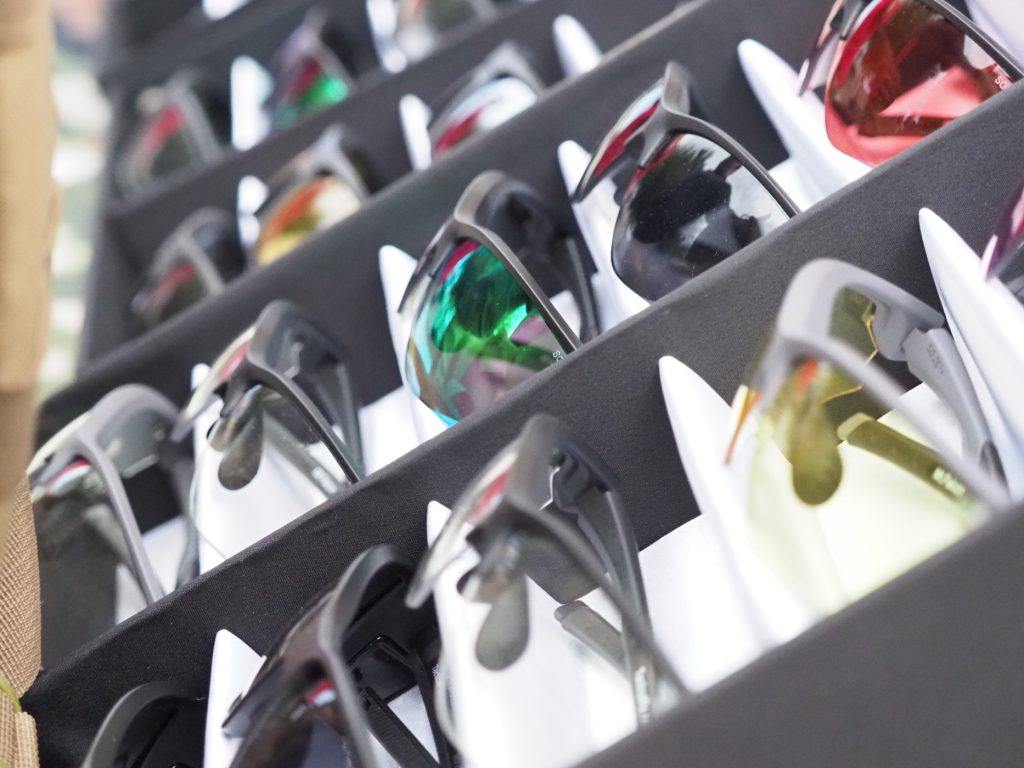
Polarized lenses cut glare rather than simply dimming everything, and the real payoff is fatigue rather than clarity. You are not squinting all day. Relaxed eyes travel with relaxed shoulders, and standing in bright sun through a full class or match is tiring even when you are doing very little.
Three limitations to know.
True polarization is only available in darker tints, generally blocking 75 to 85 percent of visible light before any mirror coating is added. The polarized colors are gray, brown, G-15, rose, and copper. Anything marketed as polarized yellow is a compromise, and most of them are neither strongly polarized nor really yellow anymore.
Polarized lenses can interfere with LCD displays. That shows up with some rangefinders, chronographs, and electronic devices. If those are part of your routine, test before committing.
And polarization does nothing about impact. A polarized lens with no Z87+ rating is a nice pair of sunglasses.
Anti-reflective coating
Uncoated lens material reflects roughly eight to nine percent of incoming light off its two surfaces, meaning you are seeing about 92 percent of what is in front of you. Anti-reflective coating brings that to roughly 99.5 percent.
There is a reason the glass in every quality optic you own has it.
On eyewear it matters most on flatter lenses, where light entering from behind bounces off the back surface and into your eye. That is the ghosting and self-reflection you get from cheap sunglasses. Deeply curved lenses suffer less from this by geometry. On clear and yellow lenses, anti-reflective coating is a meaningful clarity upgrade rather than a necessity.
Eye fatigue is a fit problem before it is a lens problem
Ask about reducing eye fatigue on the range and most answers go straight to tint. Tint is the second half of the answer.
Eyewear that does not seal against your face lets in wind and dust. You blink more. Your eyes dry out. That is fatigue, and no lens color fixes it. Solve the fit and you have solved the protection problem and most of the fatigue problem in a single purchase.
Then actually wear them. Pushed up on your hat, they are decoration. By the time something is in your eye it is too late to put them on, which is the same logic behind carrying a gun you hope never to need.
Care, and how people destroy expensive lenses
Nearly all modern protective lenses are polycarbonate, not glass. Polycarbonate is what makes the impact performance possible in the first place, and it is also softer and more chemically vulnerable than glass. Almost every lens care mistake comes from treating it like glass.
Never wipe a dry lens. This is the single biggest one. Moisten first, with a spray cleaner, a water bottle, or the sink, then wipe with a clean soft cloth. Microfiber or clean cotton both work fine.
Your shirt is a sanding block. Cotton is an acceptable material. The shirt you have been wearing for six hours is loaded with airborne dust, and dust is sand. That is the source of the fine scratch haze that shows up on every pair after a year.
Skip paper products. Paper towels and tissues are made of wood fiber. You would not rub your lenses on a tree.
Be skeptical of pre-moistened towelettes. They get lenses visibly clean, but there is not enough liquid to float grit off the surface before the wipe drags it across. Convenient, and quietly abrasive over a season.
No ammonia based glass cleaners. Those are formulated for glass. On plastic lenses and their coatings, the chemistry can craze and crack the surface.
Heat destroys lenses. Ninety five degrees outside is roughly 165 degrees inside a closed vehicle. Lenses buckle out of frames from heat alone, coatings delaminate, and shapes distort permanently. Do not store them on a dash, in a glove box in summer, or anywhere near a dishwasher.
Chemicals destroy them faster. Sunscreen, insect repellent, gasoline, solvents, and your own sweat can all attack lens surfaces and coatings. The failure mode is crazing, a fine surface bubbling or cracking that does not polish out. If you get something on a lens, rinse it immediately under warm running water with real pressure behind it. Making that a weekly habit regardless is cheap insurance.
On anti-fog, factory applied coatings typically need reactivating with drops every week or so anyway, which makes a good aftermarket anti-fog drop worth more than its price suggests and considerably cheaper than paying for the premium coating.
One reason all of this matters more than it does with ordinary glasses: on protective eyewear, scratches are not purely cosmetic. A heavily scratched or crazed lens has degraded optics and compromised structure at the same time, and it will not perform the way the rating says it should.
Every serious shooter has a threshold where they stop buying the cheap glasses. For most people that threshold gets crossed on guns first, then holsters, then optics, and eye protection never quite makes the list. It should be near the top of it. Everything else on that list is replaceable.
If you are due for an upgrade, take a look at the protective eyewear we carry. And if you wear a prescription, start with our guide to prescription safety glasses before you spend anything.
Train right, train often, train safe.