Good afternoon, everyone, and welcome back to TFB’s Silencer Saturday, brought to you by Yankee Hill Machine, manufacturers of the new Victra 20-gauge shotgun suppressor. This week we are looking at the new silencers from Strategic Sciences. In an age of new and creative suppressor designs, this is clearly the most out-of-the-box one yet.
Silencer Saturday @ TFB:
Strategic Sciences is a newer name in the suppressor space. The Canadian side of the company, Millbrook Strategic Sciences, won a Canadian special operations silencer contract back in 2025. The US arm of the company is just called Strategic Sciences, and is based in Utah (like a surprisingly large portion of the silencer manufacturers, including Dead Air, SilencerCo, HuxWrx, Amtac, and now B&T, which relocated here recently).
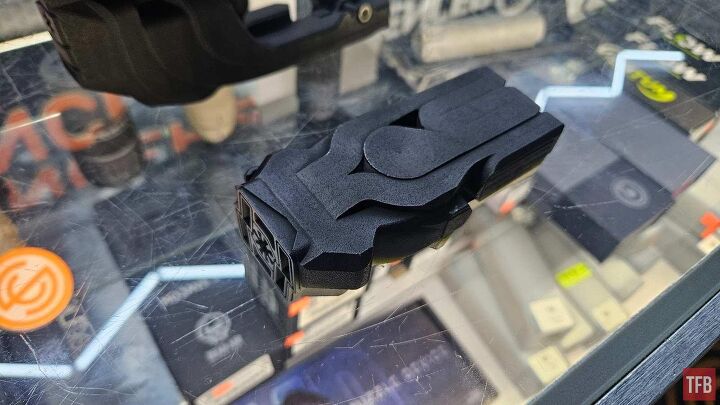
Their silencer is called the “Multi Function Muzzle Device” or MFMD. On top of sound reduction, it also acts as a brake and a flash suppressor. The MFMD is aggressively and obviously different. The ports on the front of the silencer are offset, sitting out of line with one another. The body is mostly rectangular, but has protrusions and irregular surfaces. As far as I understand it, the inside of the suppressor contains a series of passages that the gasses follow as they expand. This delays the forward venting until well after the bullet has exited. There is a video on the Strategic Sciences site that shows this with great clarity.
The MFMD looks alien. One big thing that stands out is how asymmetrical it is. I own a lot of silencers, and have shot quite a few more, and every one of them was symmetrical. Some are not cylindrical, like the SilencerCo Osprey, but even that one still looks the same on both sides despite the eccentric design. The MFMD has a series of internal passages that allow the gas to expand along a lengthy path. That extra distance and space offers lots of time for the gas to cool.
This family of silencers includes a wide range of models suiting different cartridges and barrel length options. Bore diameter options range from 5.56mm to .375-caliber. And purchasers have the option of black, green, or FDE colors. Some models also include a secondary unit that snaps on to the muzzle-mounted portion, called the Suppressor Device or SD. Some models have a larger one, called the Suppressor Device Extended or SDX. Prices start at $1,799 for models without an SD or SDX, and go up to $11,500 for one of the .50 BMG models. That price point is clearly looking for military contracts, and the MFMD will not be challenging the Polonium K or YHM Turbo for dominance in the affordable silencer market.
The CANSOFCOM contract seems to have been the beginning of Canadian military use rather than the end. It was recently selected to be the suppressor for the Canadian CMAR program. The details on the specific model are not public yet, but an MFMD is clearly mounted on the Colt Canada rifle shown in the officially released images. It is not pictured with an SD or SDX unit, but that is not a final answer on whether it is included in the contract rifle. It’s also been seen tested with the US Army’s M7 NGSW rifles and equipping some 10th SFG rifles.
Gallenson’s Guns is a Strategic Sciences dealer, and they had one on the shelf that I took a look at. Pictures of it mounted on guns make it look larger than it is. It's not much longer than a standard centerfire rifle can, but it is heavier. There is a lot going on inside the suppressor, and holding it in your hand you can tell there is a lot of material creating the interior structure. Here is a video of Emerson from Gallenson’s mag dumping the MFMD to show it in action. While I have not shot one yet, the guys at the store who have were impressed with the performance.
Here are some pictures of the MFMD and SDX:
The forward vents on the MFMD match up to gaps in the back of the SDX, this allows the gas to flow into that additional expansion chamber. Hooks on the top and bottom of the SDX attach to the MFMD unit. Everything about this suppressor system is out of the box, except that it is more rectangular and therefore more boxy than the average cylindrical suppressor. Perhaps this is a harbinger of future silencer designs. Most suppressors have been cylinders because those are easy to machining with traditional equipment like lathes. But in a world where silencers are made with 3D printing, who knows what shapes will become common!
DEALERS: If you want your link to buy YHM suppressors included in future Silencer Saturday posts, email: [email protected]