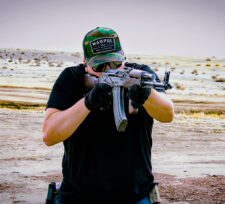
Sling Manipulation for Home Defense: Making Slings Work Around Corners
A rifle sling is often treated as little more than a carrying strap. For a gun owner relying on a rifle, shotgun or pistol caliber carbine for home defense, that is a mistake.
A properly set-up sling helps retain the rifle, frees a hand when necessary, and gives the shooter more control in hallways, doorways, and other confined spaces. A poorly adjusted sling can bind the rifle, slow a shoulder transition, or leave the gun swinging around when the shooter needs both hands.
In a recent training video, Travis Haley of Haley Strategic demonstrates how sling configuration affects shoulder transitions, body exposure around corners, and the shooter’s ability to keep a rifle in action after an injury. Haley discusses those techniques primarily through the lens of close-quarters operations, but several of the underlying lessons have direct value for civilian gun owners who keep a carbine for home defense.
Home Defense Is Not a Team CQB Mission
Haley begins by separating military close-quarters battle from civilian home defense. A trained entry team may keep rifles on the dominant shoulder while moving through a structure because several armed people are covering different angles. The point man is not expected to solve every problem alone. The homeowner usually is.
There may be no second rifle covering the opposite side of a doorway and no teammate watching the hallway. That makes body position, exposure, and weapon control especially important.
It also means movement should not be automatic. However home defense situations are not like static ranges and movement may become unavoidable. A parent may need to reach a child. A family member may be calling from another room. The defender may need to move from an exposed area to a more secure position.
When that happens, the sling becomes part of the problem or part of the solution.
Why Shoulder Position Matters Around Corners
Haley demonstrates a right-handed shooter approaching a left-side corner while keeping the rifle mounted on the right shoulder. The optic may barely clear the edge of the wall, but much of the shooter’s head, chest, shoulder, and firing-side arm are already exposed. That is one of the most important lessons in the video.
The muzzle’s position does not necessarily tell the shooter how much of his body is visible. A gun owner may believe he is carefully slicing around a doorway while unknowingly presenting a large portion of his upper body.
Moving the rifle to the shoulder closest to the corner can reduce that exposure. It does not make the shooter invisible, but it does present much less of a “target” to a potential threat. It simply gives the defender another option.
However, the rifle’s sling must allow that option.
Three Ways to Work the Rifle Around a Corner
Staying on the Dominant Shoulder
The simplest method is keeping the rifle on the strong shoulder. This preserves the shooter’s most practiced stock placement, trigger control, sight picture, and weapon manipulation. Under stress, simplicity has real value.
The downside is increased exposure when working around the opposite side of a doorway or wall.
That does not make the technique wrong. A smooth strong-side presentation may still be more effective than a sloppy shoulder transition the shooter has barely practiced.
Pushing the Rifle Across the Body
The second method is to create slack in the sling and push the rifle toward the opposite shoulder while keeping the dominant firing hand on the pistol grip. This can reduce exposure without requiring the shooter to completely change hands.
Haley warns that keeping the same trigger finger does not mean the shooter has preserved the same trigger control. Reaching across the body changes the wrist angle, shoulder pressure, head position, and stability of the rifle.
It can work, but it is not identical to a normal strong-side shooting position.
This technique should be practiced during dry fire and then tested on the range. It should not be treated as something the shooter can improvise under stress simply because it looked easy in a video.
Completing a Full Shoulder Transition
The third method is a complete shoulder change. The shooter transfers control of the rifle, moves the stock across the sling, switches firing hands, and establishes a more conventional shooting position from the opposite shoulder.
This is generally more stable than simply pushing the rifle across the body. It may also reduce how much of the outside elbow and upper torso are exposed.
The tradeoff is added complexity. Support-side shooting requires practice. The trigger, safety selector, optic, light controls, and stock position all feel different. The shooter must also complete the transition without allowing the muzzle to sweep across family members or anything else he is unwilling to destroy.
What Makes a Good Defensive Sling?
The training highlights several features that matter more than a brand name. A defensive sling should adjust quickly. The shooter may need to tighten it for retention, loosen it for movement, or create enough slack for a shoulder transition. The sling should not interfere with the safety selector, charging handle, magazine release, weapon light, or optic. It should also allow the rifle to be brought into action without forcing the shooter to fight through excess material.
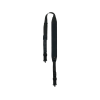
Finally, the sling should give the shooter more than one way to manage the rifle. That is where a convertible sling such as the D3 Pro can offer a practical advantage.
A traditional two-point sling gives the shooter strong control over the rifle. It can secure the gun against the body, help with retention, and keep the rifle from swinging freely when the shooter needs a hand for another task. The disadvantage is that some shoulder transitions require additional sling manipulation. The shooter may need to introduce slack, move the stock over or through the sling, and then retighten it later.
A single-point configuration permits faster movement between shoulders because the rifle is not attached at two separate points. That can be useful in very tight spaces or when rapid movement is required. Single-point slings also have disadvantages. When released, the rifle can swing into furniture, walls, legs, or the shooter’s body, usually into their groin area.
A sling like the D3 Pro allows the shooter to use a two-point setup for general control while retaining the ability to convert to single-point mode when greater freedom of movement is needed. The D3 Pro sling gives the shooter options without requiring an entirely different piece of equipment.
The advantage is flexibility, provided the owner has practiced using it.
Live Inventory Price Checker
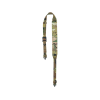
|
Haley Strategic D3 Pro Rifle Sling with GrovTec QD Swivel Nylon Multicam | MidwayUSA | $ 115.00 |
|
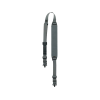
|
Haley Strategic D3 Pro Rifle Sling with GrovTec QD Swivel Nylon Gray | MidwayUSA | $ 105.00 |
|
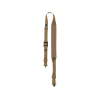
|
Haley Strategic D3 Pro Rifle Sling with GrovTec QD Swivel Nylon Coyote | MidwayUSA | $ 105.00 |
|
|
Haley Strategic D3 Pro Rifle Sling with GrovTec QD Swivel Nylon Black | MidwayUSA | $ 105.00 |
|
The Sling as a Retention Tool
Haley also demonstrates the sling’s value if the dominant arm becomes injured or unavailable. The shooter can release the rifle, reposition it, and recover it with the support hand without allowing the gun to fall to the floor. A sling also frees a hand to move a child, open a door, use a phone, or provide emergency aid. Without one, every additional task forces the defender to choose between holding the rifle and setting it down.
In a home-defense situation, placing a loaded carbine on the floor, bed, or furniture may create a new problem.
A sling does not replace weapon-retention training, but it keeps the rifle connected to the shooter and gives him more options when the situation becomes complicated.
Practice Matters More Than Hardware
These techniques should begin with an unloaded rifle and no ammunition in the training area.
Practice loosening and tightening the sling. Work on moving between shoulders without sweeping the muzzle across unsafe areas. Confirm that the sling does not interfere with the rifle’s controls or accessories.
Use a safe doorway, wall, or training barricade to understand how shoulder position changes body exposure. Speed should come later.
A sling such as the D3 Pro can make transitions and retention easier, but no sling can substitute for practice. The armed homeowner needs to understand how the sling affects movement, how to recover the rifle one-handed, and how to work from either shoulder when necessary.
A good sling should not force the shooter into one position. It should help keep the rifle controlled while giving the defender enough flexibility to protect himself and the people who depend on him.
Personally, I prefer two-point slings and use the second technique of pushing the gun across my body and keeping my dominant hand on the grip and trigger. It’s uncomplicated and fast but will require practice to perfect. Tell us your choice in the comments below!
About Duncan Johnson:
Duncan Johnson is a lifelong firearms enthusiast and unwavering defender of the Second Amendment—where “shall not be infringed” means exactly what it says. A graduate of George Mason University, he enjoys competing in local USPSA and multi-gun competitions whenever he’s not covering the latest in gun rights and firearm policy. Duncan is a regular contributor to AmmoLand News and serves as part of the editorial team responsible for AmmoLand’s daily gun-rights reporting and industry coverage.