Smith & Wesson Launches Suppressor-Optimized M&P15 AXE SBR and Pistol in .300 Blackout
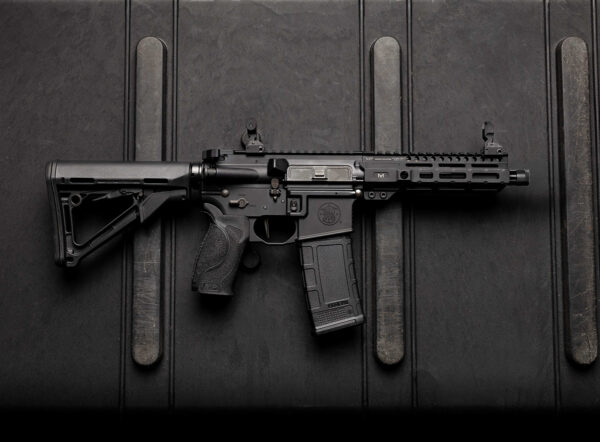
Smith & Wesson is bringing .300 Blackout to the M&P15 family with two compact firearms built around suppressed shooting: the new M&P15 AXE SBR and M&P15 AXE Pistol.
Both models use an eight-inch barrel and Gemtech’s GVAC gas-management system. Shooters can choose between a registered short-barreled rifle equipped with a conventional stock or a pistol configuration fitted with an arm brace.
Smith & Wesson built compact firearms around the qualities that have made .300 Blackout popular with suppressor owners.
An Eight-Inch Barrel Built for .300 Blackout
The AXE SBR and pistol share an eight-inch, 5R-rifled barrel with a 1:7.5-inch twist rate, an Armornite finish, and 5/8×24 muzzle threads.
Unlike 5.56 NATO, which gives up considerable velocity and produces punishing muzzle blast when fired through extremely short barrels, .300 Blackout was developed to perform from compact AR platforms. Shooters can run lighter supersonic ammunition when they want more velocity or load heavy subsonic rounds when suppression is the priority.
The fast twist should be well-suited to stabilizing the long, heavy projectiles commonly used in subsonic .300 Blackout ammunition. The standard .30-caliber muzzle threads also give owners plenty of choices when selecting a suppressor or mounting system.
Gemtech GVAC Controls Excess Gas
The defining feature of both firearms is Gemtech’s GVAC direct-impingement gas system. Suppressors increase backpressure, and that additional pressure can drive hot gas through an AR’s ejection port and charging-handle opening. Anyone who has fired a gassy, suppressed AR knows how quickly that becomes irritating.
GVAC is designed to manage more of that gas at the barrel. The system taps enough gas to operate the bolt-carrier group while using an additional chamber to hold the excess. As the bullet leaves the muzzle and pressure drops, more gas is directed forward instead of back toward the shooter.
Smith & Wesson says the system reduces blowback while maintaining reliable operation with or without a suppressor. It also eliminates the need for an adjustable gas block, allowing shooters to change configurations without reaching under the handguard to make manual adjustments.
Independent testing will ultimately determine how well GVAC handles different supersonic and subsonic loads, but Smith & Wesson is at least attempting to address a genuine problem faced by suppressor owners.
Live Inventory Price Checker
|
Smith & Wesson M&P Tactical Axe | MidwayUSA | $ 53.99 |
|

|
Smith and Wesson M&P15 Sport III 5.56 NATO Rifle - 10 Round - 16" - Hardcoat Anodized Black - California Compliant | Primary Arms | $ 749.00 |
|
| Smith and Wesson M&P15-22 SPORT 16".22LR Rifle, ODG TOPO - 14469 | Palmetto State Armory | $ 589.00 $ 579.99 |
|
|
|
SMITH & WESSON M&P15 .223/5.56 5RD MAG | Bereli | $ 318.99 |
|
SBR or Braced Pistol
The two AXE models share nearly everything ahead of the buffer tube. Both include a seven-inch Midwest Industries Combat M-LOK free-float handguard, an enhanced bolt-carrier group, a Radian Raptor ambidextrous charging handle, fully ambidextrous controls, an M&P pistol grip, a flat-faced trigger, and one 30-round magazine.
The primary difference is at the rear. The M&P15 AXE SBR wears a Magpul CTR adjustable stock and includes Williams folding adjustable sights. It weighs approximately 5.65 pounds and carries an MSRP of $1,499. As a short-barreled rifle, it remains subject to federal NFA registration and approval requirements, although the federal SBR tax has been reduced to zero. The M&P15 AXE Pistol substitutes a Magpul BTR arm brace. It weighs 5.44 pounds and carries a slightly lower MSRP of $1,479.
Smith & Wesson has entered the .300 Blackout market with two thoughtfully configured firearms rather than another pair of stripped-down ARs. The eight-inch barrel, suppressor-focused gas system, ambidextrous controls, and quality factory components make the new AXE models serious options for home defense, range use, and anyone seeking a compact suppressed platform.
About Duncan Johnson:
Duncan Johnson is a lifelong firearms enthusiast and unwavering defender of the Second Amendment—where “shall not be infringed” means exactly what it says. A graduate of George Mason University, he enjoys competing in local USPSA and multi-gun competitions whenever he’s not covering the latest in gun rights and firearm policy. Duncan is a regular contributor to AmmoLand News and serves as part of the editorial team responsible for AmmoLand’s daily gun-rights reporting and industry coverage.