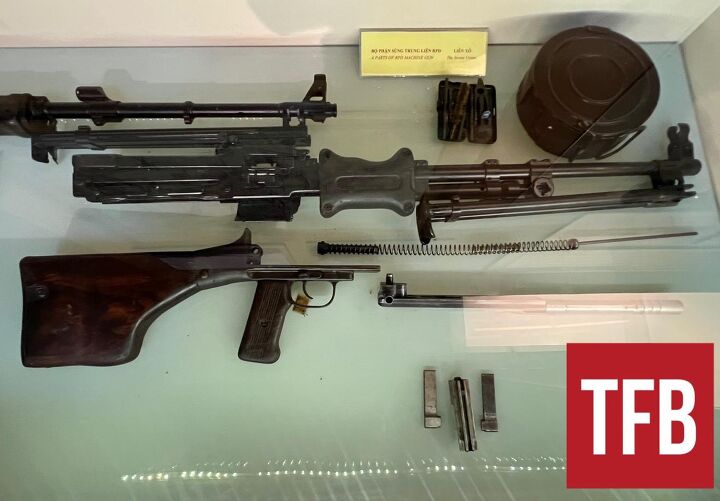
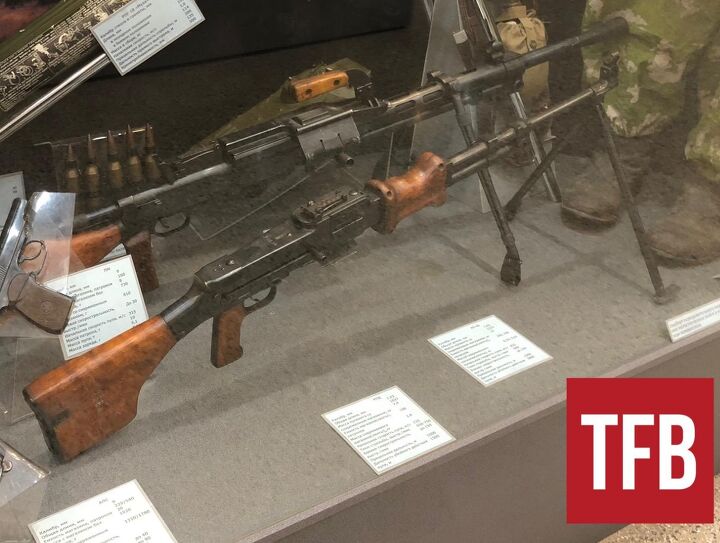
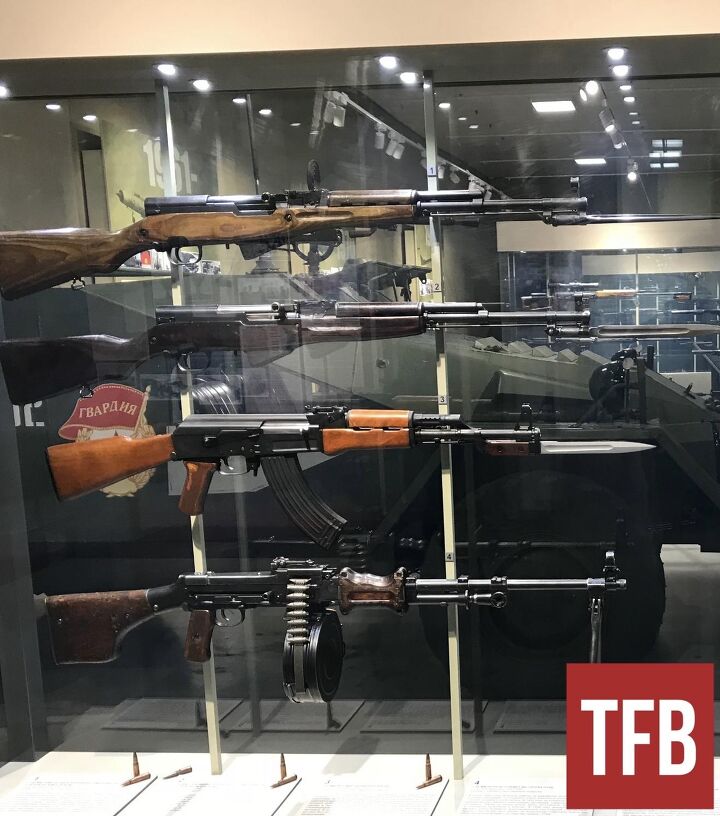
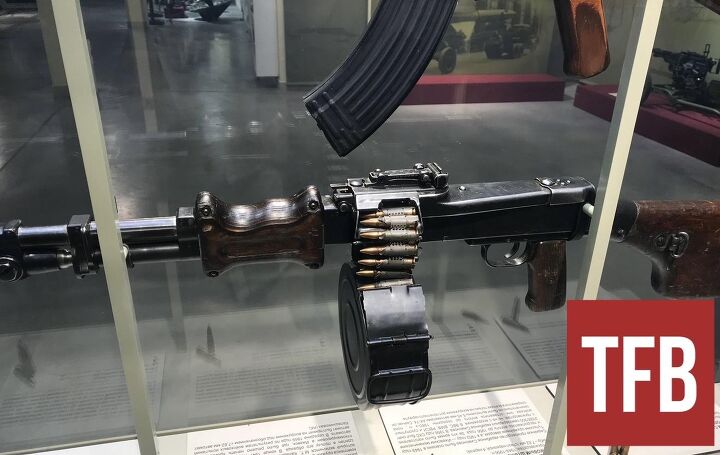
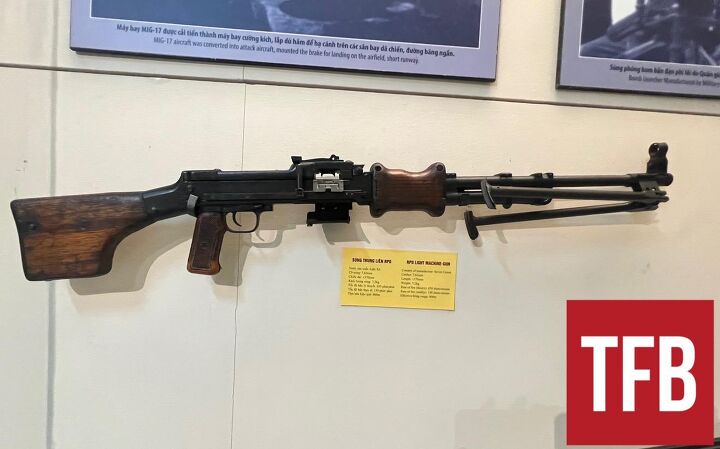
In the years after World War II, the Soviet military asked a simple question: how could an infantry squad bring a higher volume of automatic fire without surrendering mobility? A lesson they learned from the Eastern Front, where volume of fire was king. The answer, in part, was the RPD; this lightweight, belt-fed machine gun became the first Soviet weapon explicitly designed to serve as a squad automatic weapon (SAW) firing the new intermediate 7.62x39 cartridge.
Designed in the mid-1940s under the supervision of Vasily A. Degtyaryov at the Degtyaryov Plant, the RPD (РПД Ruchnoy Pulemyot Degtyaryova, “Degtyaryov’s hand-held machine gun”) emerged from the Red Army’s postwar reassessment of small-arms needs. The DP-27, the main WWII-era light machine gun, or, more accurately, an automatic rifle, used for squads and platoons, was effective at longer ranges but had limited sustained-fire capability. Still, it was bulky and heavy, built around full-power rifle cartridges that no longer matched the evolving tactics of Soviet infantry. With the adoption of the 7.62x39 intermediate cartridge in 1949 for standard Soviet small arms, the military wanted a weapon optimized for shorter engagement ranges, with greater tactical flexibility, a gun that could be carried and employed by a single soldier yet provide sustained suppressive fire for the squad.
What set the RPD apart was the combination of chambering, weight, and capacity. Chambered for the new 7.62x39 cartridge, the gun capitalized on the cartridge’s balance of reduced weight and range with capacity and controllability: powerful enough to be effective at typical combat ranges, but light and less punishing in automatic fire than full-power rifle cartridges. This arrangement gave squads a higher ammunition capacity without the bulk and complexity of heavier machine guns or heavier ammunition. It allowed a single gunner to deliver relatively longer bursts of fire when needed.
Officially adopted into Soviet service on 18 June 1949, the RPD was adopted alongside the new intermediate cartridge, the SKS carbine, and the AK assault rifle, the post-war weapons the Red Army standardized on as their doctrine evolved. During the 1950s, it became a familiar sight across Warsaw Pact armies, Soviet client states, insurgent movements, and hot spots around the world. Its global presence was the product of a deliberate political export policy to supply like-minded nations and practical appeal: the RPD was relatively simple to manufacture, mechanically straightforward to maintain, and sufficiently rugged to operate across a wide range of climates and conditions. Those qualities made it a mainstay in numerous post-WWII conflicts all the way up to the present day.
Mechanically, the RPD favored simplicity and is a downsized DP-27 or DShK-38 operating system, gas-operated and flapper-locked. Its layout was intended to provide an intermediate belt-fed machine gun with capacity. Rather than using detachable magazines, the RPD uses a metal-link non-disintegrating belt, which enabled continuous feeding for longer suppressive fire strings, with the drum serving both as a protective housing and a convenient ammunition container when on the move, but made reloads a bit awkward. Because the links did not disintegrate when fired, the belt could be reloaded and reused. However, the Soviets thought it was a logistical advantage over factory-preloaded ammunition, which the Western world would gravitate toward.
Tactically, the RPD embodied a Soviet approach that emphasized mobility and combined-arms coordination. Squads could carry the gun alongside riflemen without requiring a dedicated crew-served team. In both defensive and offensive roles, the weapon could lay down suppressive fire to support operations, then be quickly maneuvered along with the squad. The combination of the intermediate cartridge’s controllability, capacity, and the RPD’s moderate weight meant individual soldiers could easily support and maneuver with the squad. However, its days in Soviet service were numbered.
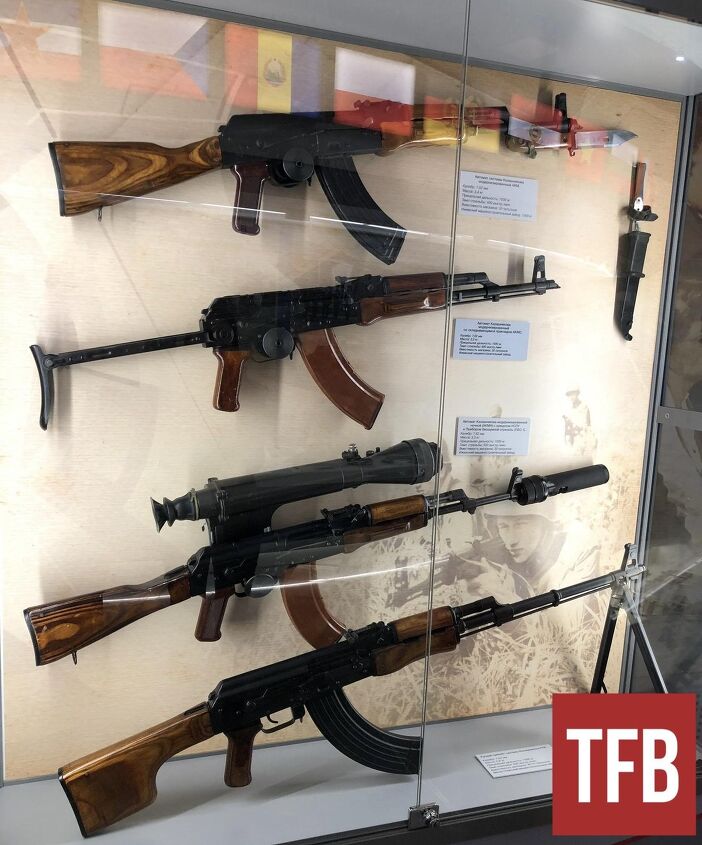
By the late 1950s and into the early 1960s, Soviet doctrine and procurement priorities began to shift. The desire for parts commonality with the increasingly ubiquitous AK led to the adoption of the RPK automatic rifle in 1959, essentially an AK-platform automatic rifle with a reinforced receiver and longer, heavier barrel intended to serve as the squad’s automatic weapon. The RPK used the same magazines, slightly larger-capacity magazines, drums, and ammunition as the AK, simplifying logistics and training. As a result, the RPD was gradually phased out of front-line units in Soviet service. However, it continued to be used by many allied militaries and irregular forces worldwide.
The story of the RPD is of a transitional solution. However, many would say it was a misguided decision to replace it, as it left Soviet infantry less effective, reducing firepower and volume of fire. The RPD provided Soviet infantry with localized support-by-fire capability, a role the RPK could never fill. It demonstrated the tactical value of a lightweight, intermediate-caliber automatic weapon at the squad level, long before that concept became standardized across many armed forces, giving the USSR a tactical advantage for a while before the RPK replaced it. The RPK represented an effort to consolidate platforms; the RPD occupied a middle ground: a purpose-built SAW that prioritized performance and sustained portable fire capability over interchangeability with the AK.
Even after its replacement in Soviet inventory, the RPD’s influence persisted. Its widespread export and use in conflicts across Asia, Africa, the Middle East, Eastern Europe, and Latin America made it one of the more recognizable postwar small arms. In many theaters, it still serves to this day, with forces that valued its simplicity and ammunition capacity. The RPD offers a clear example of how changing combat realities, shorter ranges, capacity to maintain engagements, and the rise of combined-arms maneuver, drove shifts in weapons design and infantry organization.
In the arc of small-arms development, the RPD stands as an important step: an earlier, distinct example of the now-common idea that squad-level firepower should be both portable and capable of supporting operations. Its legacy is visible not only in the weapons themselves but in the tactical concepts they enabled, a reminder that design choices in armaments are as much about doctrine and logistics as capability.