The captive-piston (integrally silenced) ammunition concept is often assumed to be a Soviet invention; in fact, it dates back to 1902 in the United States (US Patent No. 692,819). Fast-forward to the Cold War, when the KGB carried out extensive clandestine espionage and counter-espionage worldwide. The GRU, the Intelligence Department of the General Staff, shared its needs for truly quiet, concealable weapons.
The Soviet PSS Pistol and the Rise of Captive-Piston Ammunition Guns
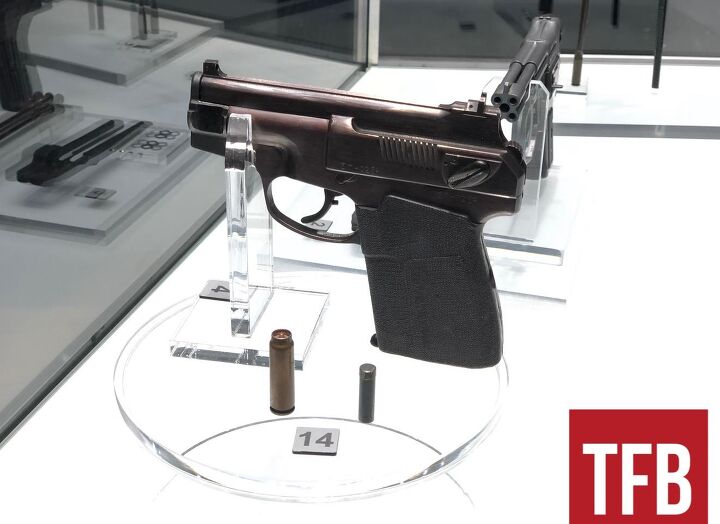
PSS silent pistol with SP-4 captive piston ammunition. By Lynndon Schooler.
The Concept
The PSS silent pistol was the Soviet answer to a very specific problem of Cold War clandestine operations, though not the first but one of a handful developed in the USSR. It was the answer to how to provide operatives and special units with a truly concealable, semi-automatic sidearm that could be fired without the telltale report and muzzle flash of a conventional pistol while being compact. Developed in the late 1970s and formally adopted in 1983, the PSS combined compact engineering with an innovative captive piston cartridge to create one of the few practical silent pistols intended for special services.

Soviet and Russian conventional pistols. By Lynndon Schooler.
Development work was carried out at the central small-arms institute in Klimovsk, where teams at TsNIITochMash designed the pistol as part of a covert armaments program. The project, known during development by the codename “Vul” and, when adopted, receiving the GRAU index 6P28, was aimed at providing the KGB and the GRU with a special sidearm that could be carried concealed and fired in close quarters without immediately giving away the shooter’s position. The designers credited with the pistol’s refinement included Krasnikov, Levchenko, Medvetsky, and Petrov.
The Ammunition
The most interesting aspect of the PSS is its departure from most suppressed weapons of the era in that it does not rely on a large, external suppressor to deaden sound. Instead, the pistol uses the SP-4 captive-piston cartridge that traps propellant gases inside the case with an internal piston at the moment of firing. That internal piston drives the bullet out of the case and then comes to rest, sealing the gas inside and preventing the high-pressure gases from exiting the muzzle, the principal source of a firearm’s report and flash. By confining the expanding gases within the cartridge, the SP-4 reduces signature while keeping the weapon compact.

The NRS-2 combat knife also uses SP-4 captive-piston ammunition. By Lynndon Schooler.
The Gun
Mechanically, the PSS is a simple, recoil-operated, semi-automatic pistol that feeds from a detachable six-round magazine. This semi-automatic action offered a practical advantage over silent revolver concepts and other single-shot silent devices. The operatives could deliver follow-up shots more quickly without manually cycling the action. In practical terms, the PSS therefore offered a much higher effective rate of fire than earlier silent designs while retaining the stealthy capability required for covert missions.
Compared with earlier suppressed weapons such as the PB, which is an integrally suppressed weapon that was a very effective covert firearm, the PSS sought a balance between concealability, capacity, and cartridge performance for the niche role. The pistol’s compact size and lack of an external suppressor made concealed carry far easier, whether tucked in a coat or hidden inside a bag. At the same time, the SP-4’s captive-piston concept meant the cartridge itself absorbed much of the sound and flash, allowing the weapon to remain compact without sacrificing stealth. As a result, the PSS has a reported sound level of 122 dB.

Soviet PB and APB with their suppressors attached. By Lynndon Schooler.
The SP-4 cartridge itself is one of the system's more ingenious aspects. While captive-piston and sealed-cartridge ideas have appeared elsewhere, the Soviet implementation delivered a compact, reliable package optimized for a special application pistol. The projectile remained subsonic and avoided the sonic crack that betrays many otherwise quiet firearms. Because the suppression was built into the ammunition, the weapon avoided the bulk, weight, and handling penalties of a suppressor, permitting a smaller weapon.
In service, the PSS filled a narrow but vital role for clandestine operatives and elite detachments, and used it where discretion mattered most. Its quiet, compact design made it ideal for very close encounters, allowing a handful of rapid, low-signature shots, useful both for emergency defense and for covert offensive tasks, without the bulk of a conventional suppressor.

PL-15 Lebedev pistol. By Lynndon Schooler.
In contrast to the OTs-38 silent revolver, which retained spent casings by design, the PSS uses conventional ejection of the spent brass, which simplifies the pistol’s mechanism. It supported the semi-automatic action, at the cost of leaving ejected brass at the scene.

OTs-38 silent revolver. By Lynndon Schooler.
Conclusion
The PSS displays the convergence of ammunition engineering and compactness requirements. By combining a semi-automatic action with captive-piston ammunition, Soviet engineers produced a practical, silent pistol that solved many of the problems previously associated with covert sidearms. Its design demonstrates how an innovative cartridge can overcome the constraints imposed by conventional suppressor systems when overall size is strict.
Now regarded as a compact icon of Cold War tradecraft, the PSS teaches a broader lesson about engineering trade-offs that sometimes the smartest fix isn’t an extra gadget but a new way of thinking about the cartridge. Produced and deployed only sparingly, the PSS nevertheless left a clear mark; its marriage of captive-piston ammunition and a compact semi-automatic pistol proved that silence can be achieved without a suppressor. These advantages came at the cost of complex and costly ammunition and weapon manufacture, especially given that subsonic cartridges paired with a short suppressor could achieve comparable sound reduction.
Related Topics: